Thursday, April 9, 2026

A Journey Around European Russia

Most of Russia's land area is in Asia, known as Siberia. But most of the population is in European Russia.

The alphabet that is used in Russia is the Cyrillic Alphabet. It was originally based on an alphabet created by St. Cyril, who was a missionary from Byzantium. The alphabet was so that people who spoke Slavic languages could read the Bible. Peter the Great, of the Romanov Dynasty which followed the Ruriks, made some of the letters look more like the Latin alphabet. He personally created the letter that looks like a backwards "R".

There is an enclave of Russia far to the west of the rest of the country, on the Baltic Sea. This is Kaliningrad. The city began with a medieval fortress built by the Teutonic Knights. Kaliningrad used to be part of East Prussia, when it's German name was Konigsberg. It was repopulated with Russians after the Second World War. The city had been part of Russia before, at the time of the Romanov Dynasty, and had also once been part of Poland.

One thing that the city is known for is a famous puzzle, known as the Seven Bridges of Konigsberg. This is a simplified illustration. It is supposedly impossible to walk a route that will cross each bridge once and only once. No swimming, tunneling or flying is allowed. It has to be only walking. It has to be one continuous walk, not two separate walks. This image is from the Wikipedia article "Seven Bridges Of Konigsberg".


THERE ARE FOUR IMAGES WITH EACH STOP. ALL IMAGES ARE FROM GOOGLE STREET VIEW 

Anyway, here is Kaliningrad.


There are multiple scenes following. To see the scenes, after the first one, you must first click the up arrow, ^, before you can move on to the next scene by clicking the right or forward arrow, >. After clicking the up arrow you can then hide the previews of successive scenes, if you wish.


Far to the east of Moscow is another medieval city on the Volga River, about a thousand years old, Kazan, that is now an important industrial city. The following scenes begin in the center of Kazan.


Well to the west, and not on the Volga River, is another major city that originated in medieval times, Voronezh.


This is Krasnodar.


Back eastward to the Volga River is the city of Saratov. The following scenes begin in the center of Saratov.


Another major city that originated in medieval times but is now an industrial city on the Volga River is Samara. I can remember that, when I was a youth, this city was called Kuibyshev.


https://www.google.com/maps/@53.189431,50.1006053,3a,75y,140h,100t/data=!3m7!1e1!3m5!1sr-sr-ZPox-CPGx0c-373EQ!2e0!6s%2F%2Fgeo0.ggpht.com%2Fcbk%3Fpanoid%3Dr-sr-ZPox-CPGx0c-373EQ%26output%3Dthumbnail%26cb_client%3Dmaps_sv.tactile.gps%26thumb%3D2%26w%3D203%26h%3D100%26yaw%3D140%26pitch%3D-10%26thumbfov%3D100!7i13312!8i6656

Finally, on the Volga River, we come to the city that is named for the river, Volgograd.

Of course, Volgograd is the city that was formerly known as Stalingrad. The greatest battle that the world has ever seen took place here, in 1942-43. It was given to the world as a glimpse of apocalypse.

But that is not what our view of Volgograd is going to focus on. In another way of looking at things, it is not fair that this quiet and peaceful city be defined solely by the battle that took place there. There was an equally horrific battle at St. Petersburg, then Leningrad, a siege that went on for nearly three years. But St. Petersburg is a larger city that has plenty of other things to distinguish it. For Volgograd, in contrast, the battle that took place there is the only thing that comes to mind.

The vast majority of people that were involved in the Battle of Stalingrad had never been to the city otherwise.

Here is what the world does not see very often, quiet scenes of everyday life in the city that was once known as Stalingrad. But you may notice that there are far fewer older buildings than there are in the other cities of southern Russia.


The Apollo Space Program

With the Artemis Space Program underway, why don't we have a look back at the Apollo Space Program? This was certainly one of the great events of history, the first time a human had stepped onto a celestial body other than earth. For those readers who weren't around yet it was a fantastic time. I followed the moon landings when I was a boy.

There is a compound posting "The Moon", August 2023. There is another compound posting, "Orbital And Escape Velocities And Impacts From Space", November 2014.

There is an important factor in the success of America's space program that I would like to add, the war that made it possible.

Credit to Wikipedia for dates and fact checking. Dates given for each mission are launch dates, unless otherwise specified.

The Space Age began with the launching of the Soviet Sputnik satellite and then Yuri Gagarin being the first man in space, sent to orbit the earth. Alan Shepard would be the first American in space, in a suborbital flight, and John Glenn would be the first American in orbit. The competition was part of the Cold War scenario.

One thing that I don't think gets enough attention as boosting America's space program is the Korean War of 1950-53. This was the first major war in which jet aircraft were widely used. It wasn't thought of at the time but being a combat jet pilot is an ideal background for an astronaut. The three most famous names from America's space age are probably John Glenn, the first American in orbit, Neil Armstrong, the first man to step onto the moon, and Buzz Aldrin, the second man to step onto the moon. All three had been jet pilots during the Korean War.

Before John F. Kennedy was assassinated he expressed the goal of putting astronauts on the moon by 1970 and bringing them safely back home. There is no doubt that fulfilling Kennedy's vision was a primary reason for the success of the Apollo Space Program.

The heroes of the space program were not all astronauts. James Webb was the administrator of NASA during the Kennedy and Johnson Administrations. His service was considered as so valuable that he got the space telescope, which might be the most important space project of all, named for him. The very expensive space program was not universally popular and it took some convincing to get taxpayers to support it.

The moon is about a quarter the diameter of the earth, about 2,000 miles or 3,220 km. It is made of rock and, since it lacks an iron core, is 1/81 the mass of the earth. The moon's surface gravity is 1/6 that of earth, helping the astronauts to carry heavy loads. The average distance to the moon is 239,000 miles, or 384,500 km.

There is no universally accepted definition of where the atmosphere ends and outer space begins. The atmosphere doesn't end suddenly, it gradually fades out. The so-called "Karmann Line" is the altitude at which an aircraft would theoretically have to fly so fast to maintain lift, due to thinning air at higher altitudes, that it would exceed the necessary orbital velocity for that altitude. But that is just a definition with regard to technology.

The earth has an orbital velocity of about 5 miles, or 8 km, per second and an escape velocity of 7 miles, or 11.3 km, per second. But that applies to ballistic objects, not to a rocket with an engine.

Once a rocket is in outer space it is not necessary to keep the engine running. The rocket will keep moving in the direction it is pointed until it encounters a gravitational field. The engine is only necessary to accelerate, decelerate, or change direction.

For a spacecraft to just take off and reach the moon is actually impossible, due to the weight of the spacecraft and the fuel it would have to carry to escape earth's gravity. But we can get around this by using stages. The Apollo rockets had three stages added, besides the Service Module with the engine that would be used in outer space.

Each stage had it's own engine, fuel tank and oxygen tank. The difference between a jet and a rocket is that the jet takes in air for combustion while the rocket, which will be operating in airless outer space, brings it's own oxygen or oxidizer. The first stage is the largest and most powerful. When it has expended it's fuel it drops away and the second stage ignites. 

The spacecraft still has the momentum built up by the first stage, but has shed it's weight. With existing fuels, and their weight to energy ratio, this is the only way to reach orbit. The first two stages were finished in about ten minutes and the third in about thirty minutes. One concern in the Apollo Program was the discarded third stage staying alongside the spacecraft, and potentially colliding with it, since the two had the same momentum.

It looks like the Artemis Program uses two stages, instead of three. America's earlier space programs, Mercury and Gemini, also only used two stages because they were only going to low earth orbit. Each successive program increased the number of astronauts by one. Mercury has one astronaut, Gemini had two, Apollo had three, and now Artemis will have four.

Rocket launch facilities are often located on the east coast of a country. This is because the earth rotates eastward and when the rocket takes off it picks up some of the earth's eastward momentum. So if something should go wrong the rocket will crash into the sea, rather than into a populated area. The moon also orbits eastward and orbits the earth in 29 days. 24 hours divided by 29 = 50 minutes, which is why the moon rises 50 minutes later each day. The launch site doesn't have to be on earth's equator but it's generally more efficient the closer to the equator it is, because the earth's spin is greatest at the equator.

A particularly challenging part of the space program was reentry into the earth's atmosphere when the mission was completed. If an unprotected spacecraft entered earth's atmosphere at the speed it was traveling through space it would burn up like a meteor. The capsule that returned to earth had a blunt bottom. This was designed to create a shockwave that carried away much of the energy involved in reentry, so that it wouldn't be manifested as heat. There was also a heat shield that would peel away layer by layer. Finally the spacecraft would splashdown in the ocean and be recovered by a navy ship.

Outer space is a very hostile environment. Small meteors will burn up in earth's atmosphere but above that there is no protection against meteors that might be traveling faster than bullets. The atmosphere also provides some protection from cosmic rays. The astronauts reported seeing flashes, even with their eyes closed, which were caused by cosmic rays. With no air to redistribute heat the side of the spacecraft toward the sun will get extremely hot while the other side gets freezing cold. This can be remedied by having the spacecraft do a gradual "roll". 

The earth is a magnet, which is why a magnetic compass works. The magnetic lines of force through space, between the magnetic north and south poles, are known as the Van Allen Belts. These protect the earth from the stream of charged particles from the sun, which cause aurora, but beyond them there is no protection. This is what causes electronics in satellites to gradually break down. 

Without this magnetic shield the charged particles could eventually strip away earth's atmosphere. This may be why the moon has no appreciable atmosphere. Lacking an iron core like earth it has practically no magnetic field.

An Apollo spacecraft would have three modules, besides the initial three stages. The Service Module would have the engine and fuel. The Command Module would house the astronauts. The Lunar Module is what would actually land on the moon, while the Command Module would remain in lunar orbit. 

The Lunar Module would be discarded once the two astronauts who landed on the moon returned to the Command Module. The Service Module would be discarded before reentry into the atmosphere, and would burn up in the atmosphere. The Command Module, slowed by parachutes before splashdown, would be the only module that returned to earth.

After the Apollo spacecraft had attained earth orbit, called a "parking orbit", checks would be done from Mission Control, on the ground. Since the moon itself is in earth orbit it is possible to go to the moon without leaving earth orbit. If an object in orbit is given a boost in the same direction that it is orbiting it will then have more orbital energy and will climb to a higher orbit. It can be boosted as high as the moon. 

It all works by the Inverse Square Law, an object that is given three times the orbital energy will climb to nine times the altitude but will move at only one-third the speed. Satellites are sometimes placed at an orbital altitude of 22,300 miles, or 35,890 km. At this altitude it will orbit earth at the same rate as the earth rotates. This is known as a geostationary orbit because the satellite can be made to stay over the same point on the earth's surface.

The same side of the moon always faces earth. Obviously all landings were done on the side facing earth because radio communication and television broadcast to earth would not be possible from the far side. Since the moon has practically no atmosphere an orbit at much lower altitude than on earth is possible, and the Lunar Module wouldn't have as far to travel.

The phase of the moon was important so the astronauts would be in daylight on the moon, not in the dark. The earth had to be visible from where the astronauts were to make possible radio and television communication with Mission Control. 

This means that a lunar mission wouldn't be done at new moon, as seen from earth, because then it would be the far side of the moon that was lighted by the sun. If the mission was done at full moon that would mean communication and television broadcast to the earth would be done at night. Around the half moon phase would seem to be best. The landing site would be chosen and then it would be lit by the sun at half moon phase, either when the moon was waxing or when it was waning.

When the astronauts ascended from the moon back to the Command Module it had to be remembered that the moon is effectively rotating once as it orbits the earth every 29 days. If the Command Module was orbiting the moon in a given time frame, and the astronauts were on the moon for two days, it would have to be remembered that the place on the orbit to meet the Lunar Module would be displaced 2/29 of the moon's circumference at that latitude, backwards or forward depending on whether the Command Module was orbiting in the same direction as the moon orbits the earth.

There was so much that had to be taken into account that "rocket science" became a euphemism for any complicated task that required a lot of intelligence.

The Apollo Space Program was preceded by the Mercury and Gemini Programs. The primary difference between the programs was the number of astronauts on board. The Mercury Program carried one astronaut, Gemini carried two and Apollo carried three. The Mercury and Gemini Programs never went beyond low earth orbit, and only required two stages.

The Mercury Program lasted from 1958 to 1963. After satellites had been put into orbit the next step was to get humans into orbit. The first Americans got into orbit on this program. Seven astronauts were initially chosen and Alan Shepard is generally considered as the first American in space, although it was a suborbital flight. John Glenn was the first American to orbit in this program. During this program NASA took over the space program from the Air Force. Because of the initial seven astronauts each Mercury capsule had a 7 in it's name, such as "Friendship 7". The local channel 7 had a morning children's show called "Rocketship 7".

The Gemini Program lasted from 1961-66. Aside from carrying two astronauts the Gemini flights lasted longer than the Mercury. The NASA Mission Control at Houston was first used. Astronauts did spacewalks, outside the capsule.

The Apollo Missions were numbered. Apollo 1 unfortunately ended in tragedy before it even began. The mission was to be the first step to the moon, a three astronaut flight in low earth orbit. On February 21, 1967, during a launch rehearsal, an electric fire started and the three astronauts suffocated. Today the town of Amherst, NY has streets named for Roger Chaffee, Edward White and, Gus Grissom.

Image from Google Street View.

There had been uncrewed Apollo missions the year before but the 1 designation was used for the deceased astronauts.

Apollo 4, November 9, 1967, was an uncrewed orbital test of the new Saturn V (5) rocket. This rocket had three stages, which would be necessary to get to the moon, as explained above. The earlier Saturn 1B had only two stages.

Apollo 5, January 22, 1968, was another uncrewed orbital test. This time a model of the lunar module, that would actually land on the moon, was attached. You can see how the space program was progressing one step at a time. Each mission was just one step ahead of the last. The Apollo missions were each designated by a letter from A to J. The simplest uncrewed test was an A mission. The final few moon landings were J missions.

Remember that the world was watching, lives were at stake, the Saturn V was a completely new rocket and this was something absolutely unlike anything that had been done before. Three astronauts had already lost their lives. It had to be done carefully and one step at a time.

Apollo 6, April 4, 1968, was another uncrewed orbital test, with all modules attached.

Apollo 7, October 11, 1968, was the first crewed mission since the three astronauts died in Apollo 1. It was a test of everything, with an actual crew, in earth orbit. There was some reported tension between the astronauts and Mission Control, and none of the three astronauts ever flew again. A cardinal rule for an astronaut is not to be difficult to work with. The astronauts had backgrounds as fighter pilots or test pilots, and so are naturally used to working alone and thinking for themselves, as opposed to being "team players".

Apollo 8 was the first mission to the moon, around Christmas time 1968. The three astronauts didn't have a real lunar module, to actually land on the moon, but did ten orbits around the moon. A primary objective of this mission, aside from being the next step, was to help select sites for the landings on the surface that would come. In a broadcast to the world the astronauts read the first ten chapters of the Book of Genesis.

Although Apollo 8 didn't actually land on the moon it is the mission that I remember the best. I had just turned 8 years old and had landed in the United States. My new country was sending astronauts to the moon. In the school library I took out the following children's book and have been interested in science ever since.

Apollo 9, March 3, 1969, was a test with astronauts and a real lunar module, but it didn't leave earth orbit.

Apollo 10, May 18, 1969, was a close rehearsal of the landing that would come on the next mission. The astronauts, from lunar orbit, used the lunar module to approach the surface of the moon just as if they were going to land. They did everything except enter descent mode, that would have taken them down to the surface. They just made sure that everything was in working order, before returning to the Command Module, that was in orbit around the moon, and then back to earth.

They came within 16 km of the moon's surface. In the video you could see the craters close-up. I was near the end of third grade and didn't quite understand why they didn't just land.

There was a story that NASA considered the possibility that the Apollo 10 astronauts might disobey orders in order to be the first on the moon. The astronauts were reportedly told that there wasn't enough fuel in the Lunar Module to get them to the surface of the moon and then back to the Command Module. I suspect that there was enough fuel, just so it wouldn't be a disaster if they did try landing, but they certainly didn't want the astronauts to know that.

The Command Modules are the only part of the Apollo spacecraft that returned to earth, with the astronauts inside. The modules are all in various museums today. The Command Module of Apollo 10 is the only one that was given to another country. I have seen this module in the Science Museum in London.

Finally the day came when humans first walked on the moon. The unforgettable day was July 20, 1969. The mission was Apollo 11. The Lunar Module descent and then ascent stages both worked flawlessly. Neil Armstrong was the first man to step onto the moon, followed by Buzz Aldrin. 

I remember a report that there was some tension over who would be on the moon first. But some of the astronauts were still in the military. Neil Armstrong was a civilian and I think it was decided that it would be appropriate to have a civilian step onto the moon first. 

The mission went almost perfectly, the American flag that they planted on the moon was too close to the spacecraft and was knocked over when the Lunar Module took off to rejoin the Command Module, which was still in orbit. The Lunar Module was jettisoned after the astronauts were back in the Command Module, and crashed into the moon.

One thing that hadn't been anticipated about the moon is how much it's surface gravity varies from place to place. This caused Apollo 11 to miss it's intended landing site by several km. In 1967 an unmanned spacecraft with a camera, Surveyor 3, had been landed on the moon. In an amazing feat of precision Apollo 12, launched November 12, 1969, landed near Surveyor 3. The astronauts removed it's camera and brought it back to earth.

All had gone well in the space program since the loss of the three astronauts in the Apollo 1 launch rehearsal. That was not to last. Apollo 13, April 11, 1970, was the most tense and dramatic event of the program, except the first moon landing. An oxygen tank exploded on the way to the moon, crippling the spacecraft. The moon landing had to be cancelled. 

The astronauts went around the moon to point them back toward earth. The Lunar Module was successfully used as a "life raft" to get the astronauts back home. Fortunately the explosion occurred before they reached the moon so that they hadn't yet discarded the Lunar Module.

The moon has mountains and Apollo 14, explored higher terrain. The astronauts had a "shopping cart" to move the scientific experiments around on the moon's surface. Seeds were brought to germinate in space, growing as the "Moon Trees" back on earth. Alan Shepard, who had been the first American in space in a suborbital flight, finally got to walk on the moon.

If modern computer terminology had been around Apollo 15 onward might have been referred to as "Apollo 2.0". Astronauts began staying longer on the moon and brought a vehicle, the Lunar Rover, to drive around on the moon. Since there is no air on the moon the Lunar Rover had to be electric. 

Exactly in the center of the following photo are a large and a small white patch of light. The photo was taken from the Apollo 15 Command Module, in orbit around the moon. The large patch of light is sunlight reflecting off the Lunar Module, down on the moon's surface. The small patch of light looks like sunlight reflecting off the Lunar Rover, parked by the Lunar Module.

Image credit to Wikipedia article "Apollo 15".

Apollo 15 brought the famous televised experiment where a hammer and a feather were dropped from the same height. Because there is no air on the moon both hit the surface at the same moment. A plaque honoring fallen astronauts was placed on the moon. A privately-owned Bulova watch was brought to the moon, which greatly increased it's value.

Trouble came again, with Apollo 16 April 16, 1972. This time it was with the main engine. The decision was made that it was not necessary to cancel the mission, although it was shortened by one day.

Apollo 17, December 7, 1972, would be the last time humans have been on the moon. Apollo 18-20 had been cancelled. There was great interest in the geology of the moon and Harrison Schmitt was a professional geologist. Five mice were brought along, to test their exposure to cosmic rays. Since the earth is rotating, and the moon is moving around earth, there is a "launch window" for the spacecraft to most efficiently reach the moon. This meant Apollo 17 had to be launched at night.

After the trouble with Apollo 16 there was a story that Apollo 17 was pushed back until after Election Day so that it wouldn't risk costing Richard Nixon the presidency if it should end in disaster. I don't know how true the story is.

The Apollo astronauts left scientific equipment on the moon, some of which is still in use. There are sensitive seismometers that can detect the impact of a discarded Lunar Module anywhere on the moon. There is a laser reflector so that the precise distance to the moon can be measured. It is known that the moon is moving away from the earth by a few cm per year because the tides caused by the moon in the earth's oceans are transferring earth's rotational energy to the moon's orbital energy.


The Apollo Space Program was followed by Skylab, and then the Space Shuttle. Skylab was placed in earth orbit and was crewed, at different times, by three astronauts doing various experiments and making observations. 

Skylab's orbit eventually deteriorated and it burned up in the atmosphere. Parts of it were found in a remote area of Australia. I saw it go by on one of it's final orbits. It was after dark but the sun was still shining on it so it looked like a bright moving planet.

The Space Shuttle was like a partially reusable space plane. Five were originally built. Like the earlier space programs it couldn't just take off into space, it was attached to a large external fuel tank and two solid fuel booster rockets which got it into orbit. Remember that direct flight into orbit is not possible with the weight of the spacecraft and existing fuels. It accomplished tasks like delivering the Hubble Space Telescope to orbit, and later servicing it.

The Space Shuttle had a crew of seven and there were two fatal mishaps, both of which killed the entire crew, the Challenger in 1986 and the Columbia in 2003. The Challenger was destroyed while taking off and the Columbia while re-entering the atmosphere. I was watching the Challenger launch live on television and wasn't sure why there were multiple lines of smoke all of a sudden.

I wonder if the Space Shuttle being designed for seven astronauts is a reflection of the original seven astronauts and Mercury missions all having a '7" in the name.

I think the greatest benefit by far of the Apollo Program were the technological spinoffs. Ronald Reagan tried to repeat the boost to the economy in the 1980s with the Strategic Defense Initiative.

There were inevitably stories that the moon landings were faked. There are places in Nevada that look like the moon. But for the moon landings to be faked, hundreds upon hundreds of people would have to be in on the secret. There is an old saying that the life expectancy of a secret is inversely proportional to the number of people that are in on it. Theories about the moon landings being faked are the domain of tabloids, not of serious media outlets.

The Apollo Space Program has left a lot for archaeologists of the future. With no water or air on the moon there is no erosion and the astronauts' footprints might last forever, unless struck by a meteor. The Lunar Modules, except for the one used to get the crew of Apollo 13 back to earth, all crashed into the moon after being discarded. 

The descent stages of the Lunar Modules remain at the landing sites, along with the Lunar Rovers of the later missions, and whatever else the astronauts left behind. There were a number of Swedish-made Hasselblad cameras left on the moon. Some of the ejected rocket stages, for the trip to the moon, remain in orbit around the sun.

But the 1960s vision of regular space travel with colonies on the moon and other planets never came to be. One reason the Apollo Program was curtailed is that public interest in it was waning, and it was tremendously expensive.

The Space Age mostly ended up giving way to the Computer Age. Anyone could never fly into space but anyone can have a smartphone. We also have to question the wisdom of sending people into space. During the Apollo years computer technology was extremely primitive. Now that has completely changed and we could just send robots, with artificial intelligence, into space. They don't need food, other than power, oxygen, or water. They don't have human emotions and we don't have to worry about getting them back home safely.

Space today is as active as ever but it is mostly about communication satellites in earth orbit and unmanned space probes out into the Solar System. But now we are back to sending humans to the moon.

The Lit Sides Of The Moon

This isn't anything breakthrough but here is something that I have never seen pointed out about the moon.

The phase of the moon that we see depends on the angle between the moon, the sun, and the earth. The visible moon is fully lit, known as full moon, when the earth is directly between the moon and the sun. The moon is not visible at all, known as new moon, when the moon is directly between the earth and the sun.

But at all other times, when the moon is partially lit, the lit portion must be either to the left or the right. Suppose that there is a crescent moon. The crescent can be either to the left, as in the first of the following illustrations, or to the right, as in the second illustration.


At the beginning of the lunar cycle, just after new moon, a crescent moon will appear in the western sky in the evening with the crescent to the right. Near the end of the lunar cycle, just before new moon, a crescent moon will appear in the eastern sky in the early morning with the crescent to the left. The lit side of the moon always faces toward the sun.

In the southern hemisphere, this is reversed. When looking toward the celestial equator, east is on the right and west is on the left. The lunar cycle, following new moon, begins with the crescent to the left and the cycle ends with the crescent to the right.

Most countries having the crescent moon on their flag have the crescent to the left. If the country is in the northern hemisphere, this means that this is the moon near the end of the lunar cycle and not the new moon.

Canada's Long-Forgotten Space Program

In the 1960s Canada had a space and high-altitude research project based not on rockets but on ballistic projectiles. A specially-built vehicle, carrying a payload, would be fired to high altitude by artillery, without any method of propulsion of it's own. It was known as the High Altitude Research Project, or HARP.

The Canadian scientist most closely associated with this project was one Gerald Bull. He later worked for Saddam Hussein, allegedly to build a "supergun", and ended up being assassinated.

This idea of launching a space vehicle with a gun is the same principle as launching it with a rocket, except that the propellant remains on the ground rather than traveling with the vehicle. But the project never did get a vehicle into space. No object has ever been launched into space from the earth's surface by ballistic means.

But that was then and this is now. I think it might be time to give this program another look, given that there are materials available today that are far stronger than any in the 1960s.

I have long wondered if there will be a new generation of guns.

Explosives generally fall into two categories, high explosives and low explosives. High explosives include dynamite and TNT. Low explosives include gunpowder and cordite. As the names imply, high explosives are much more powerful than low explosives.

Guns use the detonation of low explosives to propel a bullet through the barrel. But with an exploding artillery shell it would be high explosives in the shell. The reason that low explosives, usually gunpowder hence the name, is used as a propellant is simply that the detonation of high explosives would blast the gun apart.

The barrels and firing chambers of guns are virtually always made of steel, and it has been steel or iron for the centuries that guns have been in use. But in recent times super-strong materials have been developed, many times stronger than steel.

What if the firing chambers and barrels of guns could be made of a material that was strong enough to withstand the detonation of high explosives? That would make possible the use of high explosives, instead of gunpowder, to propel the bullet or shell. Guns would be much more powerful and have longer range.

It would not be necessary to completely replace the gunpowder with high explosives. As guns are made of super-strong materials, much stronger than steel, high explosives could be gradually mixed in with the gunpowder. This would progressively increase the power and range of the gun. 

There would be an issue with guns that are held by a person because more power would mean a stronger recoil. The firing of the gun would, of course, make more noise.

This might be called Third Generation Guns. The second generation could be defined as rifling. A rifle is a gun with grooves added to the inside of the barrel, which causes the bullet to spin. This spin cancels out random variations in the density of the bullet, which causes it to stray from a straight line. A rifle thus tends to be more accurate than a gun without the grooves in the barrel.

Now back to Canada's old project to launch a ballistic projectile into space. Exactly the same principle applies to this as to guns. Today there are super-strong materials available that were unimaginable in the 1960s. 

The "gun", as well as the launch vehicle, can be made of these new materials so that high explosives can be used as the propellant, instead of the old gunpowder or cordite. This will provide far more launching power and range, and it should finally be possible to put ballistic vehicles into space. 

Canada's long-forgotten space program was just ahead of it's time.

Canada's Avro Arrow

With a Canadian astronaut going around the moon, I wonder if Canadians might be thinking of reactivating the Avro Arrow program.

In the 1950s a Canadian company called AVRO planned what would likely be the most advanced supersonic fighter jet in the world. The plane was called the Arrow, and development began at a factory near Toronto. It was a massive project that employed many thousands of people.

Canada didn't have the facilities necessary for all the required testing of the prototype aircraft, so much of the testing was done in the U.S. The Americans who witnessed the testing of the Arrow were certainly impressed with it.

The next thing that happened was the launch of Sputnik. This was the first satellite to orbit the earth, and much of America was alarmed that their opponent in the Cold War might be pulling ahead in the arms race, and what would become the space race.

What happened next was a shock that neither Toronto, or the rest of Canada, has completely gotten over.

On February 20, 1959, remembered as "Black Friday" in Toronto, new Canadian Prime Minister John Diefenbaker abruptly and unexpectedly ordered the cancellation of the Arrow project. Everything to do with the project, the plans and tooling and several prototype planes, were ordered to be destroyed.

Not only had it employed so many people in Toronto, the plane had become a point of national pride. There are persistent rumours that plans, scale models, or maybe at least one of the prototypes of the Arrow, were smuggled to safety. It has become a Canadian legend, particularly in Toronto.

In August 2018 came the news that a test model of the plane had been recovered from the bottom of Lake Ontario.

With this project being so important to Canadians, just why was it cancelled? Certainly it was an expensive project but the plane would also serve to highlight Canada's capabilities to the world.

Part of the rationale for the cancellation might be that the Arrow was a fighter jet, designed to shoot down incoming planes as opposed to missiles, and missiles were to become more predominant in the future. But the project was cancelled in 1959. America, at the time, had Nike bases around the country, also designed to shoot down planes rather than missiles, and these would remain operational for many years after the Arrow project was so abruptly cancelled.

What I find so interesting is that considering that the cancellation announcement came after the U.S. and Canada had a chance to consider, and discuss, their response to the launch of Sputnik, the key personnel of the AVRO Arrow project were hired almost immediately by what would become the U.S. Space Program.

Many of the important positions in Apollo, as well as other programs that came before and after, were Canadians. The prominent role of Canadians in the U.S. Space Program can be seen in how, upon the mishap on board Apollo 13 in April 1970, it was the University of Toronto that was called to do the quick calculation of just the right pressure to separate the Lunar Module from the Command Module, but without doing any damage to the hatch which would be fatal. These were the days before pocket calculators and with no time to program a computer.

Doesn't it seem obvious that there was a secret deal between the U.S. and Canadian Governments that rather than dividing their responses to Sputnik, they would effectively work together by having Canada cancel the Arrow project so that it's top people could help with what would become the space program?

The reason that there was so much emphasis on destroying everything having to do with the Arrow project was to ensure that none of it's key personnel would be able to carry on the project themselves, and would accept the offer to work on what would become America's space program. In 1958, the year before the Arrow project was cancelled, the U.S. and Canada had jointly founded the NORAD defense system.

It is known that John Diefenbaker didn't always get along with U.S. President John F. Kennedy. But this was in 1959, before Kennedy took office.

THE PLANETS AND CANADIAN CITIES 

Am I the only person to think that it is the psychology of the planets that determined the locations of major Canadian cities? There were settlements across Canada but only a relative few grew into major cities, and those cities match the relative positions of the planets.

Halifax is Mercury. Quebec City is Venus. Montreal is Earth. Ottawa is Mars. Toronto is Jupiter. Winnipeg is Saturn. Calgary and Edmonton are the sibling planets of Uranus and Neptune. Vancouver is Pluto.

This is too much to be a coincidence. I have thought this for years. The logo of Winnipeg, the Saturn City, even has what looks like Saturn with it's rings. Image from the Wikipedia article "Winnipeg".

Toronto grew into the largest city, because it is in the Jupiter position. But it didn't grow into the largest city until the Space Age, when humans began sending out spacecraft and people became more aware of space. Before that it was Montreal, representing Earth, that was the largest city. 

Toronto And The Jupiter Position

For any large city, particularly in the western hemisphere which was settled relatively recently in history, the geographical reason for the city being there is usually immediately clear. Smaller cities may be located because it was a convenient stopover, or there was a particular resource located there, or it was an easily defensible location, but major cities tend to have a further geographical reason for being.

Miami is where it is because it was logical to have a port city about as far south as one can go in the peninsula of Florida, facing toward the Atlantic Ocean.

Chicago is where it is because it is just about as far south as one can go on Lake Michigan, on the western side of the lake makes it a hub for shipping out grain, beef and, ore from the Midwest and also centrally located as a railroad hub. Today it's vast airport serves the same purpose as a stopover hub for changing planes.

Vancouver, Seattle, San Francisco and, Los Angeles are on the west coast, as far as one could go west and built around good natural harbors, because the continent was settled from east to west.

Denver is where it is because it is where the high plains meet the Rocky Mountains. This made it a convenient stopover while going west before entering the mountains.

Boston is where it is because the area was settled by northern Europeans and Cape Cod formed a good natural harbor.

New York City is where it is because, not only is there a good natural harbor, but with an abundant supply of fresh water from the Hudson River.

Montreal is where it is because it is as far as ships could sail up the St. Lawrence River before encountering the Lachine Rapids. " Lachine" means "China" in French and Jacques Cartier thought that continuing along that route would lead to China.

What none of this explains is Toronto. There is no corresponding geographical reason why such a large city should be on the northern shore of Lake Ontario. The Toronto Islands form a harbor, which was enough to get the city started as Fort York, but the harbor has been relatively insignificant in the development of the city and Hamilton's harbor has a much greater capacity.

It is actually a good thing for a major city to not have a geographical reason for it's existence. We saw in the posting on the World And Economics Blog, "The Inverse Geographic Prosperity Principle", that if a major city lacks a significant geographical reason for being where it is, such as a large city in the middle of a desert, that must mean that the city is prosperous. The major city in the desert would apply to Phoenix and Las Vegas. It would also apply to Houston, although that has oil going for it.

There is one, possibly unexpected, reason why Toronto has become such a major city. The two largest cities on the Great Lakes are Toronto and Chicago. The thing that they have in common is that both of their downtowns were destroyed by fire, Chicago in 1871 and Toronto in 1904. While initially a disaster this gave both cities the opportunity to start "The Property Order" over again, as we saw in the posting by that name, January 2025, in what could be called "creative destruction". But even so, Chicago has it's geographical reason for being a major city while Toronto doesn't.

Toronto has not always been the largest city in Canada. I lived in Canada for several years as a boy and remember Montreal as definitely being the country's largest and most important city. Expo 67 was the grand celebration of Canada's centennial and there seemed to be no question that it should be held in Montreal. 

I can remember when the only tall buildings in Toronto's downtown skyline were the original two black towers of the Toronto Dominion buildings. The Royal York Hotel was much more easily visible than it is today. Image from the Wikipedia article "Toronto-Dominion Centre".

But, for some reason, Toronto kept growing and surpassed Montreal in population in the early 1980s. The growth is mostly from immigrants, it seems that just about everyone wants to live in Canada and some years it admits immigrants amounting to several percent of it's population. The following image, from Google Earth, shows what the above scene looks like today. The train tracks are still there. The two Toronto Dominion Towers and the Royal York Hotel are indicated by the three red dots.

The arrangement of Canada's major cities is amazingly like that of the planets. There were nine planets, before Pluto was controversially demoted. If we take the nine largest cities, presuming the sun to be in the east, Halifax is Mercury. Quebec City is Venus. Montreal is earth. Ottawa is Mars. Toronto is Jupiter. Winnepeg is Saturn. Calgary and Edmonton are the sibling planets of Uranus and Neptune. Vancouver is Pluto.

Everyone learns the planets in school. But through the 1960s and 1970s the world entered the Space Age. We saw that Toronto was a distant second to Montreal in 1967. But astronauts first landed on the moon in 1969. Throughout the 1970s and 80s numerous space probes ranged throughout the Solar System. Space was everywhere, in the news, on television, in stories and in movies. Almost everyone knew quite a bit about the Solar System.

The giant of the Solar System is Jupiter. It is actually much more massive than all the other planets combined. The second most massive planet, Saturn, is about one-third the mass of Jupiter. Jupiter serves as the earth's bodyguard. It acts as a gravitational vacuum cleaner and comets, and other objects, that could be devastating if they hit the earth, such as Shoemaker-Levy in the 1990s, hit Jupiter instead.

With the layout of Canada's major cities so much resembling the planets, although few if any people were consciously aware of it, Toronto had to become the largest city because it occupied what we could call "The Jupiter Position". This explains why Toronto was well behind Montreal in population and importance until the Space Age, when it had to move ahead.

I have been reading about both science and history since childhood and I can tell you that history is almost like gravity and electromagnetism as a force of nature. History is so important because we tend to repeat it, often without realizing it. This concept of Toronto occupying "The Jupiter Position" is not the only reason for it's growth but it explains why such a large city should be on the north shore of Lake Ontario, without there being any apparent geographical reason for it, at least any earthly geographical reason.

A prominent visible feature of Jupiter is it's "Great Red Spot". This is actually a storm that has been going on for centuries and is larger than the earth. Image from the Wikipedia article "Jupiter".

To correspond with this Toronto has developed it's own "red spot". On a clear night the lights of Toronto can be seen on the other side of Lake Ontario, such as atop the Niagara Escarpment at Lewiston. There is a red light visible, just like the Red Spot on Jupiter. It is the "S" on the Scotiabank tower in downtown Toronto. Image from Google Earth.

Niagara Falls And The Moon Landings

Let's review how Niagara Falls was involved with the Apollo landings on the moon. It was when the American Falls were shut off, in 1969. It ruined the tourist season on the Canadian side of Niagara Falls. I am sure that it was done in retaliation for Pierre Trudeau's incessant criticism of America's war in Vietnam.

In 1969 the American Falls, which are one of the two main falls at Niagara, were shut off by the construction of a temporary dam. This was possible because actually less than ten percent of the water flows over the American Falls because it's base is higher in elevation than that of the Horseshoe Falls. The purpose was announced as the testing of the rock strata to possibly prevent erosion of the cliff over which the water falls. There had been major rock falls the decade before, leaving a large amount of rock at the base of the falls.

The following image is from the Wikipedia article "American Falls".


There are numerous photos and videos of the nearly dry falls online. Just do a search for "Dry Niagara Falls 1969" or "dewatered Niagara Falls 1969" if you want to see more.

Remaining traces of the dam between Goat Island and the mainland, can be seen in the satellite imagery as it disturbs the water rushing over it toward the falls. It took well over a thousand truckloads of rock and soil, dumped into the river, to build the dam.


This put Niagara Falls in the news across the world. It was my first summer in America and the area around the falls were very crowded with people wanting to see the dry riverbed and the falls up close.

The Canadian side usually has the natural advantage in viewing the falls because most of the falls can be seen directly from there. The spectacle of turning off the falls made viewing from the U.S. side more popular, but harmed the tourist season overall because there was not much to be seen from the Canadian side but the bare wall of the gorge.

But why couldn't this have been done in the off-season? There was enough time between the end of the tourist season and the beginning of winter to accomplish whatever had to be done. Why tamper with the falls at all? The erosion of the base of the falls is part of the natural process, and the falls has worked it's way from it's beginning at the Niagara Escarpment at Lewiston-Queenston, at the end of the last ice age, to where it is now, by the natural process of the rushing water eroding the cliff face.

The geologists drilled holes in the riverbed, and tested the permeability of the rock layers with dye. After all of the testing was done, the decision was made that the best thing to do was to just leave the falls alone.

That is because, despite the announced purpose, this was never about the falls to begin with.

This was in no way a local idea, it originated with the U.S. Congress. The plan to shut off Niagara Falls was organized by the U.S. Army Corps of Engineers, and the dam was built by a local construction company.

The shutting off of Niagara Falls in 1969 was actually an international power play by the new Richard Nixon administration. The falls were just the stage on which this play was acted out. The dam was built in the days leading up to the first attempt to land astronauts on the moon, Apollo 11. The dry riverbed was a terrestrial reflection of the surface of the moon, in this era of Cold War posturing and propaganda, for all of the tourists who came to Niagara to see what America could do.

The monument honoring Sir Isaac Brock, a hero of the Canadian side from the War of 1812, was built so that it can be clearly seen from the American side. The following image is from Google Street View.

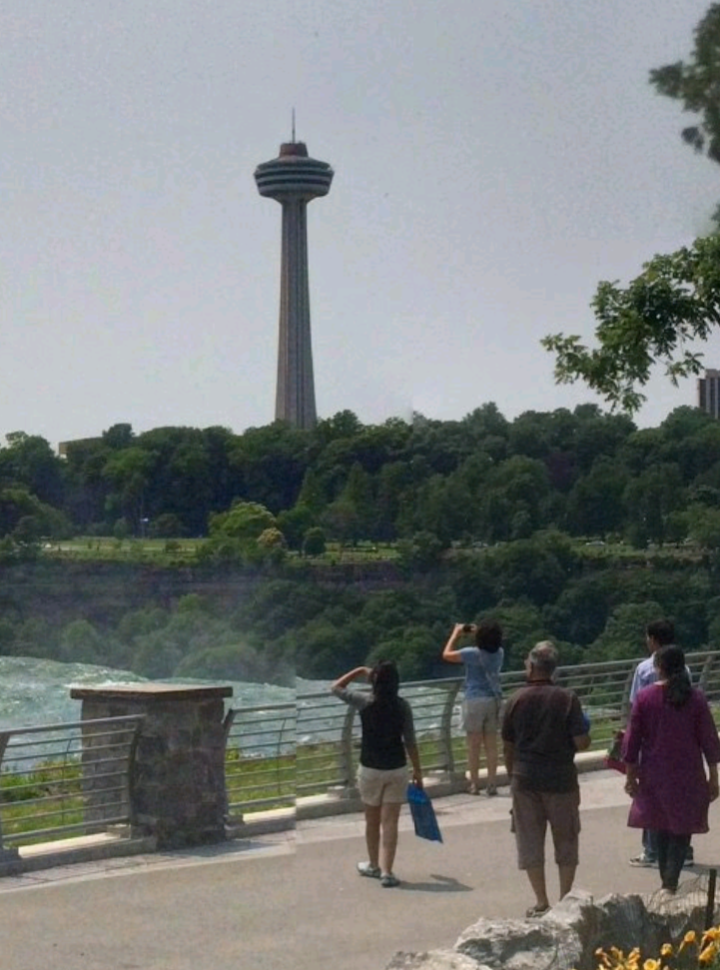
As the Space Age was underway, Canada didn't launch any spacecraft but it did build the Skylon Tower overlooking the falls with Space Age architecture. It may have appeared that the Skylon was built in the same spirit as the Isaac Brock Monument. Showing what Canada can do as there was nothing comparable on the American side. Image from Google Street View.


Shortly after humans had walked on the hitherto inaccessible surface of the moon for the first time, a ladder down to a walkway was constructed so that visitors could walk on the hitherto inaccessible riverbed for the first time. They naturally waited to make sure that the moon mission would be a success first. The following image is from the Wikipedia article "Apollo 11".


Just as tourists being able to walk on the dry riverbed of Niagara evoked the astronauts walking on the moon a few days before, the geologists examining the rock of the riverbed evoked the astronauts examining the rocks of the moon. The following image is from the Wikipedia article "Apollo 11".


Apollo 11 landed on the moon on July 20, 1969. In November of that year, astronauts landed on the moon again, in Apollo 12. This mission was also a great success. One surprise about the moon was the variation in it's surface gravity from one place to another. Because of this, Apollo 11 actually missed it's intended landing site by several km.

This was corrected in Apollo 12. More than two years before a robot spacecraft had been landed on the moon, Surveyor 3. In an amazing feat of precision, Apollo 12 landed right next to Surveyor, removed it's camera, and brought it back to earth. The following image, from the Wikipedia article "Apollo 12", is of one of the astronauts at the Surveyor craft, with their lunar module in the background.


This was also reflected at Niagara Falls. Just as humans had their first opportunity to walk on the riverbed of Niagara just after America's astronauts had first walked on the moon, the water of Niagara was turned back on by the removal of the dam immediately after the ensuing Apollo 12 had returned from it's successful mission by splashing down in the Pacific Ocean.

The shutting off of the falls lasted from the time of Apollo 11 to the time of Apollo 12. The turning back on of the falls was also a major news event. Not only could we land men on the moon, and get them safely back, we could also turn the falls off and back on again.

Despite the expense of the project, nothing was done to change anything about the falls. That is because it was never about the falls in the first place. I think that this history makes Niagara Falls, NY more interesting.

What actually happened is that Canadian Prime Minister Pierre Trudeau was incessantly critical of the conduct of America's Vietnam War. He even came to Niagara Falls to personally welcome American draft dodgers to refuge in Canada. The new U.S. administration of Richard Nixon didn't appreciate the criticism.


The announced purpose of turning off the falls was for examination of the underlying rock strata. But it had a devastating effect on the Canadian Niagara tourist season. Instead, it brought tourists to the American side to see the dry falls up close. 

This was around the same time that the U.S. broke diplomatic relations with Sweden over it's criticism of the Vietnam War. 

But Nixon and Trudeau soon patched things up. In 1972, Richard Nixon visited Pierre Trudeau in Ottawa and famously predicted that Trudeau's then-infant son would someday be Canadian Prime Minister. 


This was at a time when America was engaged in the war in Vietnam and there was also racial uprisings going on in American cities. Does anyone remember the psychedelic rock song, from 1970, "American Woman", by the Canadian band the Guess Who? It is about an alluring, but no-good, American woman. She is spurned while being told "I don't need your war machines. I don't need your ghetto scenes".

Thursday, April 2, 2026

Where Russia Began

In what is now northwestern Russia there was once a group of tribes. They had succeeded in resisting being ruled by anyone else. But the tribes just couldn't get along with each other.

They ended up seeking some order by actually inviting an outside prince or chieftain to rule over them. The one that ended up being was named Rurik. It doesn't seem to be known for sure where he was from, but Rurik was almost certainly of Viking or Scandinavian origin. Vikings that went eastward were known as Varangians.

This began, in 862, what was known as the Rurik Dynasty that would last over 700 years.

The Rurik Dynasty ruled over a kingdom known as the Kievan Rus. Vladimir the Great was a Rurik prince in Kiev who made what would turn out to be the momentous decision to adopt the Byzantine rite of Christianity for his kingdom. This was, as we saw in "The House Of Holy Wisdom, Where The Modern World Began", was because his envoys were so impressed with the Hagia Sophia in Constantinople.

The Kievan Rus ultimately broke apart, but had succeeded in being a conduit for the spread of Christianity and it is today acknowledged as the predecessor state of Russia, Ukraine and, Belarus, and is where the name of Russia comes from.

The next power that arose was the Grand Duchy of Moscow. This state gradually annexed the neighboring states that had been the remnants of the Kievan Rus, and lands to the east as well. This was still the Rurik Dynasty that had been founded centuries before.

A leader called Ivan the Great had married the niece of the last Byzantine emperor, from before Constantinople had been conquered by the Ottomans. Since Constantinople had been claimed to be the "Second Rome", the holy successor city to Rome, Ivan claimed Moscow as the "Third Rome", meaning the center of Christianity.

Finally, in 1547, the grandson of Ivan the Great, known as Ivan the Terrible, proclaimed the annexed lands as the Tsardom of Russia, with himself as tsar. But he is the one who built the magnificent St. Basil's Cathedral, in Moscow, and how terrible can someone be who can build something like that?

The place where Rurik had arrived to begin his rule over the quarreling tribes was Novgorod, to the northwest of Moscow on the way to what is now St. Petersburg. This was Rurik's capital and Ivan the Great eventually annexed what was known as the Republic of Novgorod into the Grand Duchy of Moscow, before all of it became the modern nation of Russia.

ALL IMAGES ARE FROM GOOGLE STREET VIEW UNLESS OTHERWISE SPECIFIED 

A kremlin is a walled citadel, that is usually the original part of a city. This is a look at the walls of the Novgorod Kremlin.


The Cathedral Of St. Sophia, in the Novgorod Kremlin, was completed about 1050.


Here are some aerial views of the walled Kremlin and the surrounding city of Novgorod.


In 1862, a metal monument was unveiled in the Kremlin of Novgorod to celebrate the millennium since the arrival of Rurik in 862. His arrival in Novgorod is considered as the beginning of Russia and the monument is known as the Millennium of Russia. Here are four images of the Millennium of Russia, one from each side.


The first of the following scenes in the Novgorod Kremlin is of the Millennium of Russia Monument. The figure holding the shield is Rurik. The other figures, both on the top and the bottom of the monument, are other important people from Russia's history. The adjacent cathedral, St. Sophia, was the main cathedral of the Novgorod Republic.

There are multiple scenes following. To see the scenes, after the first one, you must first click the up arrow, ^, before you can move on to the next scene by clicking the right or forward arrow, >, After clicking the up arrow, you can then hide the previews of successive scenes, if you wish.

https://www.google.com/maps/@58.5209835,31.2751234,3a,37.5y,33.81h,111.7t/data=!3m5!1e1!3m3!1sbOSDN7YUwGpqmu-8dydwZA!2e0!6s%2F%2Fgeo2.ggpht.com%2Fcbk%3Fpanoid%3DbOSDN7YUwGpqmu-8dydwZA%26output%3Dthumbnail%26cb_client%3Dmaps_sv.tactile.gps%26thumb%3D2%26w%3D203%26h%3D100%26yaw%3D50.051704%26pitch%3D0%26thumbfov%3D100

Notice how the Millennium of Russia Monument resonates with the Tsar Bell, in the Moscow Kremlin. Image from the Wikipedia article "Tsar Bell".


The city of Yaroslavl was, like Novgorod, a state that was later annexed by the Grand Duchy of Moscow. It is one of the historic cities known as the Golden Ring of Russia. The great river of the European part of Russia is the Volga River. It runs a very long route from north to south and is kind of like the Mississippi River of Russia. Yaroslavl is, like several other major cities, on the Volga River. All of these cities originated in medieval times and are now important industrial centers.

These four images are of the Assumption Cathedral in Yaroslavl.


These two images are of Elijah the Prophet's Church, in Yaroslavl.


https://www.google.com/maps/place/Yaroslavl,+Yaroslavl+Oblast,+Russia/@57.621427,39.8900489,3a,75y,90t/data=!3m8!1e2!3m6!1sCIHM0ogKEICAgIDqzZGAnQE!2e10!3e12!6shttps:%2F%2Flh3.googleusercontent.com%2Fgrass-cs%2FABsKjrxTi3DQFeocHQmxOrmjod3a3sMDlN2Kf28Hs-zAR8-ITK-OFag56D7BxPzEon3BtfTWUoCrpg0CRPeh9tXp-r3EXaZiWcqnJgaeEb9ru8hHBpEg6peO9cuky0Dl-jNxe7WzZVt7NA%3Dw203-h152-k-no!7i1200!8i900!4m6!3m5!1s0x46b291a051ecb939:0x59c9e61644948545!8m2!3d57.6260744!4d39.8844709!16zL20vMDE5Nl8w?entry=ttu&g_ep=EgoyMDI2MDIxMS4wIKXMDSoASAFQAw%3D%3D

The city to the east of Moscow, on the Volga River, that used to be called Gorky has been renamed Nizhny Novgorod. "Novgorod" seems to mean something like "new town" and the original Novgorod has been named Veliky Novgorod, to distinguish the two cities. Nizhny Novgorod is known for it's prominent Kremlin. These three images are of the walls of the Nizhny Novgorod Kremlin.