Thursday, September 15, 2022

America And Royalty

I was an immigrant to America when I was a child, having lived in Britain and Canada before. Let me tell you about the greatest surprise about living in America.

I knew that America was a republic, there was no royalty or nobility. We recited the Pledge of Allegiance every morning in school, which emphasized that America was a republic.

America was led by a president, whose wife was the First Lady, and there was a vice-president. There was to be no royalty here.

But if we wanted to go out for food, there was Burger King and Dairy Queen. The nearest department store was named King's. A popular local brand of frozen food was Freezer Queen.

Someone was always being billed as the "King of this" or the "Queen of that". Elvis Presley was the "King of Rock And Roll" and Aretha Franklin was the "Queen of Soul".

Portions were often described as "King-sized" or "Queen-sized". Innumerable products and businesses had "Palace", "Royal" or, "Crown" in their names, or a crown in their logo.

A popular soft drink was Royal Crown Cola and a top-shelf whiskey that was advertised was Crown Royal Whiskey.

Many products for girls had "Princess" in their titles. The local high schools were sometimes in the news with their Class Princesses, Prom Queens and Homecoming Queens.

Decks of cards that were used for games in America still had a king and queen.

The nickname of nearby Buffalo was the "Queen City", because it was the largest city in New York State after New York City. But one of the boroughs of New York City was named Queens and the nickname of New York State was "The Empire State", as if it was ruled by an emperor.

Americans followed Britain's royal family at least as closely as Brits or Canadians and, really incredibly, the presidency of John F. Kennedy, one of America's most popular presidents, was nicknamed "Camelot", which was the court of the legendary King Arthur.

Shouldn't Elvis Presley have been the President of Rock and Roll and Aretha Franklin the First Lady of Soul? Wouldn't it sound more like a republic if Buffalo's nickname was the Vice-President City? Doesn't "Burger President" sound more patriotic for Americans than Burger King?

But this is a very good illustration of how historical momentum works. Royalty has been removed from America's official sphere but is thriving in it's unofficial sphere. 

The world has been ruled by royalty since the beginning of civilization, and the drafting of a constitution isn't going to change that. In America, royalty has just been shifted from the official sphere to the unofficial sphere.

The same principle sometimes applies to economics. Markets have been where buying and selling has been done for thousands of years, typically with haggling or negotiating over prices. If a government tries to go against this history by fixing prices, the usual result will be an unofficial "black market", where buyers can get what they want but at "real" prices.

Historical momentum can also be seen in something like the Caste System of India. The Indian Constitution of today does not recognize the Caste System, but the historical momentum of centuries is not going to just go away.

What it really looks like, at least unofficially, is that America has come back into the royal fold and Harry and Meghan are it's king and queen.

An Explanation Of Christianity

Since so much that happens in the world is based on historical religious patterns, even if it is in modern secular form, why don't we review the history of Christianity?

Christianity is based on Jesus being the awaited Messiah. The Jewish scriptures foretold the Messiah and the ones who accept Jesus as that Messiah are known as Christians. All of this is foretold, and told about, in the Bible. The Christian Old Testament is basically the Hebrew Scriptures, written before the time of Jesus but foretelling His Coming. The New Testament was written after Jesus and it describes and interprets His life and teachings.

The reason for Jesus as Messiah is to save people from their sin. Christianity is not people reaching up to God, it is God reaching down to us. No human has ever been free of sin, it entered humanity through Adam's disobedience. 

But if sin can enter through one man then salvation from sin can also enter through one man. God sent Jesus, His only begotten Son, down here to pay the price for our sin. Jesus was without sin so when he was unjustly crucified, really because the religious authorities were resentful of His popularity, he paid the penalty for all who will accept Him as your savior. 

When God judges someone who has accepted Jesus as their saviour, He judges Jesus instead. So instead of seeing that person's sin, which would make it impossible for that person to enter Heaven, He sees Jesus' lack of sin and then the person can enter Heaven.

There was debate in the early church about the exact relationship between Jesus' divine nature and His human nature, since He had to have both. The nature of this relationship is referred to as "Christology". Some defined the relationship as "two natures in one". Others thought that the two natures of Jesus must be completely separate and still others thought that the divine nature absorbs the human nature.

The majority of Christians accepted the first position, that of "two natures in one". The reason that we do not hear much about Christology nowadays is that the three major branches of Christianity, Catholic, Protestant and, Eastern Orthodox all accept this position. This relationship was affirmed at the Council of Chalcedon and so the three main branches of Christianity are sometimes referred to as "Chalcedonian" Christians.

The Coptic Church of Egypt and Orthodox Church of Ethiopia take the position that Jesus' divine nature just absorbs the human nature. The "Church of the East", or Nestorians, believe that Jesus' two natures remain completely separate. These Christians are neither Catholic nor Protestant nor Eastern Orthodox. Note that "The Church of the East" is not the same thing as Eastern Orthodox.

The vast majority of Christians in the beginning were Catholic. There are actually more than twenty Catholic churches, all in communion with the pope but using different rites. About 98% of Catholics belong to one of these, sometimes called the Latin Church. The other Catholic Churches are often denoted by nationality or ethnicity, such as the Greek Catholic Church or the Ukrainian Catholic Church.

The Roman Emperor Constantine, the first Roman Emperor to be a Christian, founded a city in the east that was named for him, Constantinople. This eastern part of the Roman Empire spoke Greek, while the western half spoke Latin. After the fall of the western Roman Empire the eastern half continued for a thousand years as Byzantium, or the Byzantine Empire.

The Catholic Church was led by the pope, based in Rome. The pope claimed to be the successor to St. Peter, who seemed to be the most prominent of the apostles with Jesus. Much of the New Testament was written by St. Paul, who came afterward and never met Jesus on earth. But many Christians questioned why the pope had to have such power, or why they needed to be led by a pope at all. 

In the east many Christians questioned the authority of the pope. The papacy responded by founding the Holy Roman Empire to unite Europe to rein in the Christians of the east. Charlemagne was crowned as it's first emperor. Despite the name the Holy Roman Empire was mostly centered in Germany.

The eastern Christians finally split away, in what is known as the Great Schism of the year 1054. The pope sent representatives to meet with the Patriarch of Constantinople. The meeting didn't go well and the eastern Christians split away to form the Eastern Orthodox Church. 

The eastern church had been using a different rite from the western Catholic Church, the Byzantine instead of the Latin Rite. The eastern church also spoke Greek, rather than Latin. A major boost for this eastern church, before it broke away altogether to form the Eastern Orthodox Church, was the selection by Prince Vladimir of the Byzantine Rite for his kingdom of Kievan Rus. He then returned home to baptize the population of Kyiv.

Vladimir had been baptised in Crimea and this might explain why both Crimea and Kyiv are so important to the Russian Orthodox Church. The modern nations of Russia, Ukraine and, Belarus are all descended from Kievan Rus.

The Eastern Orthodox Church was based in Constantinople which was conquered by the Ottomans in 1453. The logical place to move the focal point of the church would be Kyiv, but it had been so devastated by the Mongols that it would take centuries to regain it's former position. So the focal point became a new major city, known as Moscow. Unlike Constantinople or Kyiv Moscow, as a major city, has never been Catholic.

I see a parallel here with the story of Ireland. First the story of Prince Vladimir quite resembles that of St. Patrick, except that St. Patrick had no royal title. The breakup of the Soviet Union left sites that are so historically important to the Russian Orthodox Church, Crimea and Kyiv, in a foreign country. 2022 is the centennial of the modern nation of Ireland and the drawing of the border with Northern Ireland has left the places most associated with the life of St. Patrick, in County Down and County Armagh, outside of Ireland.

Even with the splitting away of the Eastern Orthodox Church, in 1054, the Catholic Church reached the height of it's power in the Thirteenth Century even though the Crusades, the military missions to take control of the Holy Land, were ultimately unsuccessful. Also the Holy Roman Empire was becoming a rival to the papacy over the Investiture Controversy, the question as to whether the pope had the right to appoint or remove emperors.

There was a split in the Catholic Church that lasted about seventy years when the King of France refused to submit to the pope. A succession of French popes reigned from Avignon, in southern France, rather than Rome. At any given time there might be several claimants to the papacy, before the crisis was resolved.

A century after that was resolved came the second major permanent split in the Catholic Church. In the Fifteenth Century the Catholic Church tried to reform itself. Church offices were being sold for money. Popes were effectively controlled by one or another rival wealthy families. Money donated to the church was going so that cardinals could live in palaces.

If the effort at reform had succeeded the Protestant Reformation might never have happened. The Reformation began in 1517. The name most associated with it is Martin Luther, in what is now eastern Germany. But it was a spontaneous movement that had been brewing for quite some time. The other prominent early Reformation figure is Huldreich Zwingli, in Switzerland.

Essential to the Reformation was the newly-invented printing press. Bibles could now be mass-produced and there was no reason that people couldn't read the Bible for themselves in their own language, instead of listening to mass in Latin. But that was a threat to the authority of the Catholic Church and they put a lot of effort into suppressing it.

Across northern Europe people decided that it was time to separate from the Catholic Church and do things their own way. But the papacy decided to stop them by force, and the result was over a century of warfare.

Reform of the Catholic Church did happen, but it took this second major split in the church to bring it about. Much of what the Catholic Church is today comes not from the original church but from the Counter-Reformation, which the papacy implemented after the Protestants had separated in the Reformation. One new order that was created was the Jesuits, the Society of Jesus, of which the present Pope Francis, who has praised the Reformation, is a member.

The Protestant ideal is freedom. Anyone can study the Bible for themselves and start their own church. People can think for themselves and decide which church to join or how to interpret the Bible. There is no Protestant version of the pope or the Vatican. Let the people be free and think for themselves, instead of being told what to believe. Our modern concept of freedom would not exist without the Reformation.

But some of the new Protestant churches kept much of the Catholic liturgy because people were familiar with it. This included the Lutherans, the church named for Martin Luther even though he only wanted to reform the Catholic Church and didn't intend to start a new church.

Luther and Zwingli were the leaders of the first generation of the Reformation. The next generation brought John Calvin and John Knox. Calvin was puritanical in that he wanted just the Bible, purified of all the man-made sacraments and rules that the Catholic Church had added onto it. John Knox was an outstanding preacher who turned Scotland from a bastion of Catholicism into one of the most Protestant of nations. The Scottish Protestant church that resulted is the Presbyterians.

England joined the Reformation after it was already underway in continental Europe. But Catholicism was still tolerated and the decision was not unanimous, there was a short-lived rebellion in northern England against the Reformation. Queen Elizabeth I created the Anglican Church, or Church of England, as an effort at compromise between Puritans and the remaining Catholics. 

The Anglican Church kept so much of the Catholic liturgy that it is sometimes called "Anglo-Catholicism", although there would be no control or influence from the Vatican. Just as in Catholic days there are two Anglican archbishops in England, at York in the north and Canterbury in the south. Most Protestant church leaders are called "ministers" but Anglican leaders are still called "priests".

Even today the Anglican Church, which is now a family of churches called the Anglican Communion, is said to consist of a "high church", representing the Catholic side, and a "low church", representing the Puritan side. This compromise church didn't please everyone, many Puritans wanted nothing to do with Elizabeth's church. The English Civil War wasn't between Protestants and Catholics but between Anglicans and Puritans. The Puritans won but afterward fell out of favor. Some left for Massachusetts and that is where the Pilgrims and Puritans came from.

But the Anglican Communion is the largest single Protestant denomination today. When America declared independence from Britain the Anglican Church there was separated from the rest and renamed the Episcopal Church, but it has since rejoined the Anglican Communion.

At Oxford University a group felt that the Anglicans should be more active in helping people. From their orderly way of doing things this group became known as "Methodists". The Methodists would grow into a major separate denomination, no longer considered as Anglicans. In efforts to help people the Salvation Army is a Methodist creation.

Central to Protestant belief is the Puritanism, the elimination of man-made additions in favor of just the Bible. The Baptists were one of the early branches of the Reformation. Also important to Protestants is the direct experience of the Holy Spirit, no need to go through popes and archbishops and man-made sacraments. The Pentecostal Church began in the U.S. and the Evangelical movement has spread across the world.

In the late Nineteenth Century the world grew more secular. Can you believe that there were people saying that, since wars tend to be religious in nature the Twentieth Century should be a much more peaceful century. It didn't quite work out that way.

People are designed to believe in something and when they don't believe in God they will just believe in something else. The Nazis took people who, for the most part, no longer believed in God and did an outstanding job of giving them something else to believe in.

The established patterns of religion are the basis of our economic and political systems. The organization of Soviet councils was very similar to the organization of the Eastern Orthodox Church. The Nazis' "National Socialism" was between Capitalism and Communism just as Lutherans were Protestants but kept much of the Catholic liturgy. When people fell away from following the pope they just followed dictators instead, and the Twentieth Century was certainly the century of dictatorships. The Protestant principle that anyone can start their own church is reflected in the capitalist principle that anyone can start their own business and the democracy principle that anyone can start their own political party.

Thursday, September 8, 2022

Queen Elizabeth

Queen Elizabeth was 96 years old and we knew that this day was coming. When I read the news this morning that she was under medical supervision and her family members were rushing there I thought that this might be it. I am a native Brit and this is the first time in my life without Elizabeth as my queen.

News

Donald Trump made a speech this week in Pennsylvania praising Vladimir Putin and Xi Jinping. But remember what we saw in the posting on this blog, "The Theory Of Kings" April 2022. Monarchy has been the way societies have been governed for thousands of years, and is not about to just go away. All three of these are really kings, if not actually in name, and kings tend to stick together. As we saw in the posting, this explains so much about the world.

There is a lot of concern that the Great Salt Lake, in Utah, is in danger. It would be a good idea to see exactly what the Great Salt Lake is. In my geology theory, "The Story Of Planet Earth" on the geology blog www.markmeekearth.blogspot.com , it is described in section L) EMERGENCE CENTERS ACROSS THE WORLD as one of twelve magma emergence centers that are evenly spaced across the world. Eight of them are on two interconnected straight lines. The book-length theory leaves no major features of the earth's surface unexplained, either on land or on the seafloor, and these evenly-spaced magma emergence centers are something that has never been pointed out before.

This summer there has been catastrophic flooding in Pakistan and catastrophic drought in Europe. The prevailing winds at that latitude are westward but the air is dropping so much water in the Monsoons of the Indian subcontinent that further west the Middle East, and now Europe, is very dry. But there is something that we can do. The Monsoons, like the hurricanes of the western hemisphere, require a lot of dust in the air, to act as condensation nuclei. The dust for the hurricanes of the western hemisphere is swept up by the wind from north Africa. The dust for the Monsoons comes from the vast dry Outback of western Australia. We saw in "The Australia Sequence", on the Progress Blog, that we could remedy this by digging a canal so that the Great Artesian Basin, which is below sea level, fills with water. This water would evaporate and fall as precipitation over the Outback, turning it green instead of dusty and solving the problem. Here is a link to the original posting: www.markmeekprogress.blogspot.com/2012/03/australia-sequence.html?m=0

Thursday, September 1, 2022

In Memory Of A Truly Great Leader

This is what I posted here almost three years ago, in September 2019, when I read that Mikhail Gorbachev was ill. It was titled "Tribute To A Great Leader". In posting each week I usually put the visit first, when something comes before the visit it means that it is really important.


When a famous person dies, they are remembered and their accomplishments reviewed. During my youth, there was a great world leader that changed my view of and way of thinking about the world. This leader will likely be leaving us one of these days. So why not have the tribute before his death?

Mikhail Gorbachev became leader of the Soviet Union in 1985. The ill and aging Konstantin Chernenko was not expected to live much longer and I awoke to the morning newspaper proclaiming Gorbachev as being proclaimed the new leader after Chernenko's death.

Mikhail Gorbachev was a leader like the Soviet Union had never seen before. He was charming and a match for Ronald Reagan as "The Great Communicator". Gorbachev knew that Communism had to be reformed and introduced the two new policies of "Glasnost" (openness) and "Perestrouka" (restructuring). He made many enemies at home among the "Old Guard" of Communists.

Gorbachev has just so much in common with Martin Luther. Just as Martin Luther always considered himself as a Catholic, he only wanted to reform the church and didn't want to start a new church certainly not the Lutheran church with his name on it, Gorbachev sought to reform Communism and always still considered himself as a Communist.

But what both had in common is that they opened doorways to reform, but then couldn't control what followed them through those doorways. Martin Luther, the reform seeker, was followed by men who had no intention of reconciling with the Catholic Church and an entirely new branch of Christianity began with the Reformation, the Protestants.

Likewise Gorbachev, seeking only to reform and modernize Communism, was followed by Boris Yeltsin who publicly destroyed his Communist Party membership card. Communism in the Soviet Union, as well as the Soviet Union itself and Gorbachev's rule of it, ended on Christmas Day of 1991.

But the end of the Cold War, which came in 1989, would never have been possible without Mikhail Gorbachev. The expansion of the European Union into eastern Europe would never have happened.

Gorbachev had a great effect on me. I had been sure that countries like America and Britain were always in the right when in conflict with other countries. But this magnetic and eloquent Russian, even if he couldn't speak English, caused doubts to begin to creep in. I decided that no one should think that they are above anyone else and one of the results of that is these weekly visits on this blog to places across the world.

With this blog, I am now in a position to promote peace and understanding in this world and that is exactly what I am going to do. All of these wars are just so pathetic. God gave us all that we need here to build a paradise, and this is what we do with it. There is a problem with the world and human nature is that problem, and we have got to overcome it by relying on the Word of God.

Does anyone remember when Gorbachev used the term "God on High", and the Soviet news agency tried to censor it?

I would like to proclaim Mikhail Gorbachev as the most important person of the second half of the Twentieth Century.

This Week's News

FLOODING IN PAKISTAN

I don't usually express sympathy here for the simple reason that, if I express sympathy to one group, then, in fairness, I would have to express sympathy for everything that happens everywhere and this would just be a blog of sympathy.

But Pakistan is special and this flooding is catastrophic. Any nation that can produce chapati like Pakistan does is truly special.


RECENT TURMOIL IN IRAQ AND LIBYA

There was recent political turmoil in Iraq. Libya was also in the news this week. The country is still sharply divided between east and west. This illustrated the political principle that I call "The Strong Leader Binding Phase". If a nation was put together artificially it will require an extended period of time being ruled by a strong leader of some description before it is ready to be a democracy.

The end of the First World War, in 1918, also brought the end of the Ottoman and Austro-Hungarian Empires, and this brought a number of new nations into existence, including Libya. The two new nations created from remnants of the Austro-Hungarian Empire, Czechoslovakia in the north and Yugoslavia in the south, lasted only as long as Communism did.

Along with Libya the end of the Ottoman Empire brought the creation of Iraq and modern Syria. In all of these nations, consisting of diverse ethnic, religious or, linguistic groups, it is necessary to have rule by a strong leader, whether a king or dictator, to bind the country together before it is ready to be a democracy.

Too many people had the idea that all that is necessary is to remove a dictator and democracy will bloom like flowers in a garden. But, as we can see by the removal of Saddam Hussein, the result is much more likely to be chaos, unless some kind of occupation force is closely managing the transition.

America went through it's Strong Leader Binding Phase under the rule of English kings before gaining independence. I believe that the underlying cause of the U.S. Civil War, of 1861-65, was the premature interruption of the Strong Leader Binding Phase, by the Declaration of Independence in 1776.

Here is a link to the original posting about Libya:

www.markmeekeconomics.blogspot.com/2014/01/a-few-words-about-libya.html?m=0 

How can we know when the Strong Leader Binding Phase is completed? Another principle is "The Second Leader Rule". If the necessary strong leader is followed by another leader who is of much lower profile, we know that the revolutionary or strong leader phase has been successfully completed. Here is the link to that posting:

www.markmeeksideas.blogspot.com/2016/12/the-second-leader-rule.html?m=0

THOUGHTS ON THE WAR IN UKRAINE

Is anyone wondering what is going to happen to all of these weapons when the war is over? The reason that the world is so awash in used weapons and military equipment is that, when wars end, much of the weaponry ends up getting sold all over the world.

Remember that much of the information that emerges in a war is less-than-believable. Does anyone remember, in the First Gulf War of 1990, there was the story that Iraqi soldiers had gone into a hospital where there were premature babies in incubators. The Iraqis were reported as having taken the incubators after having thrown the babies on the floor, leaving them to die there.

It was known that the story wasn't true but the public was allowed to believe it, until after the war, in order to build support for the war effort.

THE FORGOTTEN CAUSE OF THE SECOND WORLD WAR

Today is the anniversary of the official beginning of the Second World War. The usual story is that everything was going along just fine until Adolf Hitler suddenly appeared and wrought devastation on the world.

Except that isn't quite what happened. The Weimar Republic was a democracy that was working well. The 1920s were a time of great prosperity, especially in the U.S. With the leftover industrial capacity from the First World War factories turned out a vast array of goods, from radios to cars. 

But workers were not being paid enough to be able to afford the goods that they were producing. Industries naturally wanted to be able to sell their goods for as much as possible, while paying workers as little as possible, in order to maximize profit. Goods were just piling up in warehouses. Factories began cutting back on production, meaning that workers had even less money, and it spiralled into a devastating crash.

The 1930s were a terrible time, Germany was economically devastated by the crash. A party called the National Socialists, or Nazis, emerged with an idea. Unemployment would be absorbed by drastically expanding the armed forces. Factories would be brought back to full production making military equipment for them.

The plan worked absolutely brilliantly, the only downside is that there was a world war. A lot is made of the mistake of demanding that Germany pay the full cost of the First World War. But let's not forget that the Second World War likely wouldn't have happened without this 1929 market crash.

This market crash is also what made Communism into a major world system, an alternative to capitalism. Prior to this only a few intellectuals in the west even knew what Communism was.

MAR-A-LAGO

I know that I keep referring to the compound posting, "America And The Modern World Explained By Way Of Paris" December 2015, but it is absolutely essential.

Why would Donald Trump bring government documents about nuclear weapons to his Florida home? It emerged recently that Trump maintained a file on the private life of French President Emanuel Macron.

Remember that the Republican Party of America is really the continuation of the French Bourbon Dynasty, that was overthrown and guillotined in the revolution of 1789. This had been America's first ally and the one that helped it to gain independence.

The French Revolution might not have succeeded if not for the Storming of the Bastille, a fortress in Paris, and the seizure of the guns and ammunition stored there. This gave armaments to the revolutionaries and left the royalist forces in Paris virtually defenseless.

History is so important because we tend to repeat it, often without realizing it. The nuclear documents represent the vital guns lost in the Bastille. Donald Trump was, perhaps subconsciously, bringing them back into the security of his Mar-A-Lago estate. The modern French President represents the revolutionary forces that overthrew and guillotined America's close allies, that is what led Trump to maintain a file on him.

HISTORY REPEATS ITSELF IN THE BUFFALO AREA

Here is something in the local area where this is being written.

In 2009 a passenger plane crashed in Clarence Center, east of Buffalo, killing everyone on board. The incident led to much in the way of new regulations about issues like how much flight experience a pilot had to have, before flying passengers, and how much rest between flights.

In 1867, in the town of Angola which is about the same distance from downtown Buffalo as Clarence Center, a passenger car on a train detatched and slid down a hill. The incident is known as "The Angola Horror". At the time there were still different rail gauges and wheels were designed to slide between them, but this reduced stability. 

The Angola Horror led to the reform of passenger trains in a very similar way that the Clarence Center crash would lead to the reform of passenger planes 142 years later. Ironically the number of people killed on the train and in the plane were identical, both 49. In the plane crash an additional person was killed on the ground.

Review Of Margaret Thatcher

Readers in presidential democracies might not completely understand it but the race to succeed Boris Johnson is not a general election. As we saw in our visit to "London" in a parliamentary democracy one votes for the party, more than for the candidate as in a presidential election. If a prime minister becomes unpopular the ruling party can simply replace him with someone else and continue to govern. The ruling Conservative Party has actually chosen to make this succession race more public than they had to.

The Conservatives seem to want to choose whoever best carries the mantle of Margaret Thatcher.

My mother and Margaret Thatcher lived for exactly the same number of days. My mother's death is listed as June 9 but that is because the hospice nurse didn't arrive until after midnight.

Here is a link to "Margaret Thatcher In Perspective", the posting that I wrote following her death in 2013:

www.markmeekeconomics.blogspot.com/2013/08/margaret-thatcher-in-perspective.html?m=0 


Thursday, August 25, 2022

Commentary On Recent News

AMERICA'S STUDENT LOAN FORGIVENESS

Let's thank President Biden for this forgiveness of student loans. This was a very wise move. Other western countries don't have this issue of so many millions of people with oppressive student loans.

The Law of Supply And Demand works as the underlying basis as our economic system but not as the entire basis for that system. In my view there are places that capitalism doesn't belong. These places include justice, medicine and, education.

We do not live in a free country if someone in court is found innocent or guilty, or wins or loses a court case, according to the quality of the lawyer that they can afford.

Basing medical treatment on capitalism is very destructive. For a country to be strong it's people must be healthy and strong. It is very advantageous to diagnose and treat a medical condition as soon as possible. But that often does not happen if the person does not have medical coverage or is worried about how much it is going to cost. For a person to have to declare bankruptcy because they got sick or injured is absurd and destructive to the entire society.

If you are robbed the police try to solve it without any charge. If you have a fire the fire department puts it out without any charge. If your country is attacked the military defends you without any charge. Why should it be any different if you get sick?

We are competing against other countries. Everyone should be developed to their maximum education and skills potential, regardless of their financial situation. If we don't do this we will fall behind other countries.

THE QUEEN OF CANADA

A Philippine immigrant, named Romana Didulo, has proclaimed herself as "Queen of Canada", and has gained a considerable following. She also reportedly wants Americans to follow her, and to establish America as a kingdom.

But remember what we saw in the posting, "The Theory Of Kings", April 2022. Nations have been monarchies for thousands of years. Something that has been around for thousands of years is not going to just go away because of the drafting of a constitution. So much of what goes on in the world is explained by what I call "The King Factor". Constitutional monarchy is valuable because when a country does not have a king it risks falling under the rule of a demogogue that acts like a king.

PROPHETIC WARNING FOR EUROPE?

There is a severe drought in Europe and major rivers are drying up. This has revealed a lot of vehicles, boats, various war equipment, and sometimes unexploded bombs, from the Second World War that have not been seen since the end of that war. At the same time war is raging in Ukraine.

Is this a warning from God that it might be a good idea to turn back to him?

YEP

How many people say "yes" anymore, outside of a work environment and job interviews? Languages change over time, we use "you" instead of "thee" and "thou". The new word begins as what we refer to as slang. Most people say "yep" nowadays with "yeah" being a less formal, or less decisive, form of "yep". "Ain't" didn't used to be considered as a real word. Now it is in the dictionary, although no one seems to use it anymore.

Although I don't use the word myself I would like to welcome "yep" to being an official part of the English language.

NO MORE AVENUES, DRIVES, ROADS OR CRESCENTS

I notice that when people refer to an address but are not putting the address on an envelope or package they almost always use either just the name or say "street". Very rarely, unless they live or work there, does anyone say "avenue", "drive", "road" or, "crescent".

Is it maybe time to drop these designations and just call everything a "street"? Having a street and avenue with the same name just invites confusion.

TELEPHONE POLE NAVIGATION

We are so dependent on GPS for navigation yet GPS satellites can be shot down. The GPS system can be jammed and may also be vulnerable to severe solar storms.

Wherever humans settle there are telephone poles. Once again, why don't we attach a number to every telephone pole and then use that for a backup navigation system? This is so simple.

NO SCHOOL SHOOTINGS THIS YEAR

Instead of bringing a gun to school there is something that is far more effective. Why not bring God to school? If you sincerely follow the Word of God you are entering God's Kingdom. If someone messes with you they are messing with God's Kingdom and God will cause nasty things to happen to them. This goes for people that persecute you, organizations that treat you unfairly and, families that interfere in your personal business and try to be in control.

Thursday, August 18, 2022

The Power Of Multiplication

Here is just something to think about.

Most people remember the classic example used in school to illustrate the surprising power of successive multiplication. Suppose a laborer did some work for someone for a month. The employer asks the laborer how much he would like to be paid. The laborer answers " a penny on the first day doubled every day so that I would be paid two cents on the second day and four cents on the third day and so on and I must be scheduled for at least thirty days.

"Wow, what a bargain this is" thought the employer as he agreed to pay the laborer as he requested. However, the employer did not stop to consider the power of successive multiplication and had to pay the laborer over ten million dollars (or pounds, euros, rupees, etc,) for thirty days work.

One day while messing around with a scientific calculator I discovered what I consider as a more space age example of the power of successive multiplication. Consider a roll of pennies that is stored in cash registers. There are fifty pennies in a roll, or we could just take any stack of fifty coins. We could vary the position of the pennies in the roll and also flip each penny so that the heads side is facing one way and tails the other or vice versa.

I calculated that in this roll of pennies, there are more possible combinations than there are atoms in the entire universe.

The number of atoms in the universe is believed to be about 10 (79) or a 1 followed by 79 zeroes. If we take the factorial of 50 (50!), which is 50 x 49 x 48... back to 1, it will give us the number of possible combinations in the sequence of pennies in the roll. I come up with 3.04140932 x 10 (64).

Remember that we can also flip each penny in the sequence for heads or tails to face in a given direction. So, we would take 2 multiplied by itself fifty times and multiply it by the first number. We get 1.125899907 x 10 (15). This gives us a total of 3.42432247 x 10 (79). In other words, within our roll of pennies, there are three possible combinations for each and every atom in the entire universe.

75 Years Since The Partition

Next year India is projected to become the most populous nation on earth. The world needs more roti and more curry and more tea. I nominate Pakistani-style chapati as the single best food in the world.

Indians should celebrate the western hemisphere. When Christopher Columbus sailed westward he was hoping to find a way to India. The native people of the western hemisphere are mistakenly called "Indians" because Columbus thought that he had landed in India. See the compound posting, "The Western Hemisphere" August 2021, section 3) INDIA AND COLUMBUS DAY.

This week is the 75th anniversary of the Partition of India and Pakistan. The nation of India was divided by religion into Hindu-majority India and Islam-majority Pakistan. Pakistan was in two halves, East and West Pakistan. In 1971 East Pakistan declared independence to form Bangladesh. Hindus that happened to live in what would become Pakistan had the option of moving to what would become India, as did Moslems living in what would become India to move to what would become Pakistan. Not everyone moved, there are still some Hindus in Pakistan and Bangladesh, and today there is almost as many Moslems in India as there are in Pakistan. 

In the east the state of Bengal was divided into East and West Bengal, East Bengal became East Pakistan and West Bengal is centered around the Indian city of Kolkata. In the west three states became West Pakistan and the state of Punjab was divided between the two. Sikhs generally chose India, although the Pakistani city of Lahore is important in Sikh history and there are still Sikhs in Pakistan. In the 1980s there was a Sikh movement to separate from India to form a state called "Khalistan".

We all know that Hindus moving in one direction and Moslems moving in the opposite direction were sometimes not very nice to each other, and maybe a million people died in the Partition. Families that were separated by the Partition are avidly using social media to reconnect. This was a monumental event in the history of the Twentieth Century.

There are three postings that I see as very relevant to the Partition.

The reason that this event is so critical is that the border between India and Pakistan is the most active frontier between what I see as the two halves of the world. The world can be divided between the "North And East" and the "South And West".

https://markmeeksideas.blogspot.com/2016/04/understanding-world-in-terms-of-south.html 

At least the Partition of India was done along religious lines. What if religion had been ignored and India hadn't been partitioned? Have you ever contrasted the Partition of India to Yugoslavia or the breakup of the Ottoman Empire? Here is a link to the posting, "How Secularism Leads Us Astray":

www.markmeeksideas.blogspot.com/2020/04/how-secularism-leads-us-astray.html?m=0

One thing that occurred to me concerning the contentious relationship between India and Pakistan, since the Partition, is actually how it is an inadvertent repetition of European history. Spain and Portugal were the first European countries to build large empires in the Imperial Age. The Portuguese were the first Europeans in India. Has anyone ever stopped to think that India and Pakistan are replaying the Imperial Age relationship between Spain and Portugal? The same goes for the Middle East after Israel was restored, the year after India and Pakistan became independent.

In the compound posting, "How History Repeats Itself" November 2019, read section 4) THE SEPARATION AND THREE WARS RULE. I find the similarities to be truly amazing.

Hyderabad

One side of the Partition that doesn't get much attention is the many "Princely States" that existed within what is now India and Pakistan. There were many Princely States that together held a significant proportion of India's population. It took some negotiation and coercion but all of the Princely States eventually agreed to join either India or Pakistan. One of the former Princely States is still an issue today between the two countries. It is Kashmir, in the far north.

I have wondered if India's former Princely States inspired those "homelands" that South Africa created in the 1970s. Has anyone else used "Bophuthatswana" as a password?

The greatest of these Princely States was Hyderabad, which is today the name of a major city in India. The final ruler of the Princely State of Hyderabad was the Nizam of Hyderabad, Mir Osman Ali Khan. He was legendary for his personal wealth and all that he did for Hyderabad. One school that he founded has produced CEOs of both Microsoft and Adobe. He was on the cover of Time Magazine in 1937, listed as the richest man in the world. The Princely State of Hyderabad had a fantastic collection of jewels that was later purchased by the Government of India and is put on display periodically.

This is a look at the city of Hyderabad today.

Hyderabad is the central city of southern India and was founded in 1591 by Muhammad Quli Qutb Shah. Hinduism is the majority religion in India but Hyderabad has a significant Moslem population and there is a large statue of Buddha on an island in the artificial lake that was constructed at the city's founding.

Hyderabad was captured by the Mughals and became the center of what was known as a princely state. The ruling dynasty was known as the Nizams of Hyderabad. Upon the independence of modern India, most princely states joined either India or Moslem-majority Pakistan. Hyderabad initially resisted being a part of the united country.

Hyderabad hosts the headquarters of many international companies in India. Another thing that it is known for is diamonds.

Golkonda Fort was constructed by the founders of Hyderabad, and was the first part of the city. Nearby is the Qutb Shahi Tombs of the Nizam rulers.

There are multiple scenes following. To see the scenes, after the first one, you must first click the up arrow, ^, before you can move on to the next scene by clicking the right or forward arrow, >. After clicking the up arrow, you can then hide the previews of successive scenes, if you wish.

https://www.google.com/maps/@17.3836126,78.4017736,2a,75y,184.19h,90t/data=!3m7!1e1!3m5!1sdnMk6WWteeyxoIPzSML3fA!2e0!6s%2F%2Fgeo3.ggpht.com%2Fcbk%3Fpanoid%3DdnMk6WWteeyxoIPzSML3fA%26output%3Dthumbnail%26cb_client%3Dmaps_sv.tactile.gps%26thumb%3D2%26w%3D203%26h%3D100%26yaw%3D184.00085%26pitch%3D0%26thumbfov%3D100!7i13312!8i6656

Charminar means "four minarets or towers". This landmark of Hyderabad and of India was constructed when the city was founded. I think it has inspired many other structures. Nearby is the Chowmahalla Palace.

https://www.google.com/maps/@17.3616406,78.4746747,2a,75y,49.72h,90t/data=!3m7!1e1!3m5!1scKpw83zVCRcAAAQIt6Civw!2e0!6s%2F%2Fgeo1.ggpht.com%2Fcbk%3Fpanoid%3DcKpw83zVCRcAAAQIt6Civw%26output%3Dthumbnail%26cb_client%3Dmaps_sv.tactile.gps%26thumb%3D2%26w%3D203%26h%3D100%26yaw%3D48.394367%26pitch%3D0%26thumbfov%3D100!7i13312!8i6656

The Salar Jung Museum is India's version of the Louvre, a great art and artifact museum.

https://www.google.com/maps/@17.3712201,78.4806529,2a,75y,105.31h,90t/data=!3m8!1e1!3m6!1scq5VVj0hyxwk6cZAK_9NFw!2e0!3e2!6s%2F%2Fgeo0.ggpht.com%2Fcbk%3Fpanoid%3Dcq5VVj0hyxwk6cZAK_9NFw%26output%3Dthumbnail%26cb_client%3Dmaps_sv.tactile.gps%26thumb%3D2%26w%3D203%26h%3D100%26yaw%3D106.00637%26pitch%3D0%26thumbfov%3D100!7i13312!8i6656

This is the area of Hyderabad around the Sama Saraswati Gardens.

https://www.google.com/maps/@17.3461838,78.5211029,3a,75y,81.6h,90t/data=!3m8!1e1!3m6!1sAF1QipOk0WOOViSLnb5U98KHYhPqmvHrDoZEIrGI6PQ4!2e10!3e11!6shttps:%2F%2Flh5.googleusercontent.com%2Fp%2FAF1QipOk0WOOViSLnb5U98KHYhPqmvHrDoZEIrGI6PQ4%3Dw203-h100-k-no-pi-0-ya81.20884-ro-0-fo100!7i5660!8i2830

Hyderabad has a well-known film industry. The following scenes begin in Annapurna Studios.

https://www.google.com/maps/@17.4267951,78.423256,3a,75y,341.51h,90t/data=!3m7!1e1!3m5!1sjj2GLevv7aFNMYNIDeNyZw!2e0!6s%2F%2Fgeo0.ggpht.com%2Fcbk%3Fpanoid%3Djj2GLevv7aFNMYNIDeNyZw%26output%3Dthumbnail%26cb_client%3Dmaps_sv.tactile.gps%26thumb%3D2%26w%3D203%26h%3D100%26yaw%3D342.3013%26pitch%3D0%26thumbfov%3D100!7i13312!8i6656

Hyderabad Public School in Begumpet was founded by the Nizam Osman Ali. In 1937, Time Magazine did the story on him as the richest man in the world, when Hyderabad was a princely state. This is the school that has produced CEOs of both Microsoft and Adobe.

Other than the Nizams another prominent family of Hyderabad was the Paigahs. They owned Falaknuma Palace.

https://www.google.com/maps/@17.3317334,78.4675623,3a,75y,145.7h,90t/data=!3m8!1e1!3m6!1sAF1QipPq2Z9hBeNHbto0XPT6QbmuK-cGGlR9O4AWNnM!2e10!3e11!6shttps:%2F%2Flh5.googleusercontent.com%2Fp%2FAF1QipPq2Z9hBeNHbto0XPT6QbmuK-cGGlR9O4AWNnM%3Dw203-h100-k-no-pi0-ya351.3101-ro-0-fo100!7i7680!8i3840

These scenes of Hitec City, modern Hyderabad, begin in the Inorbit Mall.

https://www.google.com/maps/@17.434476,78.3868881,2a,75y,259.5h,90t/data=!3m7!1e1!3m5!1sVgra7WFyzWPemcp3grcZyQ!2e0!6s%2F%2Fgeo2.ggpht.com%2Fcbk%3Fpanoid%3DVgra7WFyzWPemcp3grcZyQ%26output%3Dthumbnail%26cb_client%3Dmaps_sv.tactile.gps%26thumb%3D2%26w%3D203%26h%3D100%26yaw%3D259.5%26pitch%3D0%26thumbfov%3D100!7i13312!8i6656

Thursday, August 11, 2022

The Comeback Of Print

On the subject of Beirut, the former home of the Phoenicians who came up with the idea of writing with an alphabet, let's have another look at how much more we could be getting out of our alphabet.

Nowadays almost all of what we read is digital. Most people don't read that much in hard copy any more. Printed hard copy hasn't yet joined the dinosaurs but is clearly on the way out.

But not so fast. I see a lot that the printing and publishing industries could be doing to roll back some of the apparently inexorable gains made by digital. None of this requires any new technology, just some creative thinking.

It is a simple matter to print text in ink of different colors. In a novel or story why not assign a different color of ink to each major character? When Character A speaks the words might be printed in red. When Character B speaks the words might be printed in green. Wouldn't that make the story more lively and easy to follow?

Suppose there was an article involving two or more different viewpoints. Why not express one viewpoint in red, and another in blue? This would only be for the essence of each viewpoint. Comparisons of the viewpoints and observers' opinions would be in ordinary black ink.

By coloring and varying in shade the letters on a page of text we could easily embed a photograph or illustration in the words on each page. The photo or illustration would not be separate from the words on the page but would actually be embedded in them. This would be a novel idea that would make any book more interesting, and would be much easier to do in print than in digital.

The printing fonts in use now were not intended for this. Why not develop a new font especially for printing text and illustrations in one? The letters would take up more of the space on the page relative to present fonts, to better convey the illustrations. One way of looking at it would be the illustrations embedded in the text. The opposite way of looking at it would be the text embedded in the illustrations.

There is a lot that print could be doing to regain territory that seems to have been lost to digital. It would be relatively easy to do and wouldn't require any new technology. It just requires some creative thinking.

A More Useful Alphabet

On the subject of Beirut today, which was once home to the Phoenicians who came up with the idea of using an alphabet, let's remember that we could make the alphabet more useful by making each letter a shape or form that is commonly referred to. There could be a "Mechanical Alphabet" that exists alongside the conventional alphabet, and each letter of the alphabet would have both a mechanical and conventional form. But the mechanical letters would each be of a useful descriptive form. Maybe the conventional letters, a, b, c, ... could gradually be phased out.

Another thing that we could be doing is making use of geography. It is difficult to describe an odd shape with words, without using an illustration or photo. Geographical entities, countries, states and, provinces, come in all manner of different shapes. This gives us a ready vocabulary of two-dimensional forms, just choosing the geographical form that comes closest. Something might be described as "Kentucky-shaped". If the object is three-dimensional it can be described with two or three such forms.

Here is a link to the posting, "The Alphabet As Symbols":

www.markmeekprogress.blogspot.com/2009/06/alphabet-as-symbols.html?m=0

Recent Solar Storm

Did anyone else notice this?

On Wednesday, August 3, I was reading the news on my phone. At about 10 A.M. EST I just lost my internet connection and couldn't get it back. Restarting the phone didn't work. If I managed to get onto a website I soon lost it. I tried another phone and it was the same thing. 

In early evening I tried the phone again and everything was fine. I didn't see anything about an outage on the news and thought that maybe there was an issue with the nearest phone tower that had now been fixed.

But the following morning, August 4, it was the same thing again, although not as severe as the day before. I was able to get onto a website if I kept reloading it, and didn't lose the connection after I got to it. By early afternoon everything was fine, although again there was nothing about any outage in the news.

Then I remembered that there had been a solar storm on August 3. That explains why there was only trouble with the internet during the day. Everything was fine after sunset, until the sun rose the following morning. I could see nothing about this in the news.

Does anyone remember exactly 50 years ago, during America's war in Vietnam, Haiphong Harbor was mined by the U.S.? The mines were dropped in the harbor by aircraft and were set not to activate immediately so that foreign ships in the harbor would have the chance to leave safely. The mines were designed not to explode on contact but to sense the change in magnetic field caused by the steel hull of a passing ship. But then on August 4, 1972, there was a solar storm that caused the mines to detonate.

Thursday, August 4, 2022

Cleveland

Several U.S. presidents were from the area around Cleveland. One of the best-known people from the Gilded Age of Capitalism was Cleveland's John D. Rockefeller, who started Standard Oil here.

Cleveland was an industrial city and what was likely the turning point in environmentalism took place here. In 1969, the Cuyahoga River, which runs through Cleveland, literally caught fire. There was a vast amount of garbage floating in the river, and liquid waste floating on it's surface, and someone probably threw a cigarette in the wrong place. Around the same time, Lake Erie was declared to be a "dead" lake, due to the pollution.

Things seemed to change after that, and the following year saw the first Earth Day.

Cleveland's professional football team, the Browns, are not among the best teams today, but used to dominate in the 1950s. Like the city being named for a person, surveyor Moses Cleaveland, the Browns were named for the former coach, Paul Brown. The Browns play at First Energy Stadium, and Cleveland's well-known professional baseball team, the Indians, play at Progressive Field.

The first thing that I think of at the name of Cleveland is the Cleveland Clinic:

https://en.wikipedia.org/wiki/Cleveland_Clinic#/media/File:Cleveland_Clinic_Miller_Family_Pavilion.jpg

The city is also known for Case Western Reserve University:

https://en.wikipedia.org/wiki/Case_Western_Reserve_University#/media/File:Case_western_reserve_campus_2005.jpg

The tallest building in Cleveland is the Key Tower, like the sports stadiums, it is named for a company, Keybank:

https://en.wikipedia.org/wiki/Key_Tower#/media/File:Key_Tower.jpg

200 Public Square is another prominent Cleveland building, built by Standard Oil:

https://en.wikipedia.org/wiki/200_Public_Square#/media/File:200_Public_Square.jpg

From further in the past is the old Terminal Tower:

https://en.wikipedia.org/wiki/Terminal_Tower#/media/File:Terminaltower1.jpg

In the 1930s, the Great Lakes Exhibition was held in Cleveland. It is now the site of the Great Lakes Science Center:

https://en.wikipedia.org/wiki/Great_Lakes_Science_Center#/media/File:Clevelands_Great_Lakes_Science_Center.jpg

And the Rock and Roll Hall of Fame:

https://en.wikipedia.org/wiki/Rock_and_Roll_Hall_of_Fame#/media/File:Rock_and_Roll_Hall_of_Fame.jpg

Even though I don't listen to rock music anymore, I changed my choice of what is the single greatest song of the rock era. I once chose "Baby Blue" by Badfinger. But now my favorite song of the era is "Summer Breeze", released on the last day of August 1972 and about a happy couple at home on a summer evening. But within a few days of it's release, the massacre of Israeli athletes at the Munich Olympics would take place.

Here is downtown Cleveland with the first scene in Public Square, which was the original center of the city. You can see the three tall buildings listed above, Key Tower, 200 Public Square and, the Terminal Tower, which are all close to Public Square. the Terminal Tower is really attractive in the way it is lit up at night. The river is the Cuyahoga River, which is just west of Public Square.

There are multiple scenes following. To see the scenes, after the first one, you must first click the up arrow, ^, before you can move on to the next screen by clicking the right or forward arrow, >. After clicking the up arrow you can then hide the previews of successive scenes, if you wish.

https://www.google.com/maps/@41.5000343,-81.6936065,3a,75y,89.23h,87.41t/data=!3m7!1e1!3m5!1sCGJBw0Dl-Uyg6knqY5WMqA!2e0!6s%2F%2Fgeo2.ggpht.com%2Fcbk%3Fpanoid%3DCGJBw0Dl-Uyg6knqY5WMqA%26output%3Dthumbnail%26cb_client%3Dmaps_sv.tactile.gps%26thumb%3D2%26w%3D203%26h%3D100%26yaw%3D212.7477%26pitch%3D0!7i13312!8i6656

Most cities have a well-known marketplace. These are some scenes in the area of the West Side Market, starting in one corner of the market. The Cuyahoga River seems to be everywhere in central Cleveland, that is because of how it winds.

https://www.google.com/maps/@41.4846866,-81.7026155,3a,75y,62.11h,90t/data=!3m8!1e1!3m6!1s74xu7YgruBeDO1_MHqBaAA!2e0!3e11!6s%2F%2Fgeo1.ggpht.com%2Fcbk%3Fpanoid%3D74xu7YgruBeDO1_MHqBaAA%26output%3Dthumbnail%26cb_client%3Dmaps_sv.tactile.gps%26thumb%3D2%26w%3D203%26h%3D100%26yaw%3D54.757786%26pitch%3D0!7i13312!8i6656

This is the former industrial area to the west of downtown, known as "The Flats", and now home to Progressive Field, where the Cleveland Indians play baseball:

https://www.google.com/maps/@41.4921588,-81.6892854,3a,75y,104.16h,90t/data=!3m7!1e1!3m5!1snmoensL_mIR3KZKPRCdaSQ!2e0!6s%2F%2Fgeo0.ggpht.com%2Fcbk%3Fpanoid%3DnmoensL_mIR3KZKPRCdaSQ%26output%3Dthumbnail%26cb_client%3Dmaps_sv.tactile.gps%26thumb%3D2%26w%3D203%26h%3D100%26yaw%3D108.61843%26pitch%3D0!7i13312!8i6656

Upstate New York

All that many people can think of when they hear of New York is the tall buildings of Manhattan. But New York is not just a city, it is also the name of a U.S. state. It consists not only of New York City, but also of other cities as well as vast areas of woodland and farmland and mountains.

Let's have a look today at the four major cities of upstate New York, the New York City area is referred to as downstate. But remember that New York State is far more than cities, it is also the Adirondack Mountains, as well as the Catskills and the Finger Lakes.

The capital city of New York State is Albany. We have seen Albany on the travel photo blog of North America: The photos can be enlarged by clicking on them.

http://markmeektravel.blogspot.com/2006/09/albany-capital-city-of-new-york-state.html

A name that is often seen around upstate New York is that of Corning. It was a railroad and political family, including mayors of Albany. This photo is of the Corning Tower, the tallest building in the Empire State Plaza, with the structure to the left known as "The Egg":

http://photos1.blogger.com/blogger/5492/3756/1600/dc_250960.jpg

The nickname of New York State is "The Empire State", and there is a concourse with stores and restaurants below ground level in the Empire State Plaza.

The unique structure known as The Egg is a theater. This shows how original New York State is. Nowhere else in the world is there a concrete egg, with a theater inside:

https://en.wikipedia.org/wiki/The_Egg_(building)#/media/File:The_Egg.JPG

This is the State Legislature Building in Albany, also known as the State Capitol. which I incorrectly referred to as the Governor's Mansion on the travel photo blog:

http://photos1.blogger.com/blogger/5492/3756/1600/dc_250957.jpg

The following images are around the Empire State Plaza in Albany. The first scene is looking ahead to the State Legislature Building. Notice how the Empire State Plaza, with it's reflecting pool. resembles The Mall, in Washington DC. I had thought that the long reflecting pool represented the Erie Canal, which was so important to the development of New York State, and that the buildings along the sides represented the cities along the canal.

There are multiple scenes following. To see the scenes, after the first one, you must first click the up arrow,^, before you can move on to the next scene by clicking the right or forward arrow, >. After clicking the up arrow, you can then hide the previews of successive scenes if you wish.

https://www.google.com/maps/@42.6490687,-73.7616094,3a,75y,307.33h,90t/data=!3m7!1e1!3m5!1sz6xe7a7GisLP2xCSKBzsDA!2e0!6shttps:%2F%2Fstreetviewpixels-pa.googleapis.com%2Fv1%2Fthumbnail%3Fpanoid%3Dz6xe7a7GisLP2xCSKBzsDA%26cb_client%3Dmaps_sv.tactile.gps%26w%3D203%26h%3D100%26yaw%3D316.04086%26pitch%3D0%26thumbfov%3D100!7i16384!8i8192

One set of names that are seen all over upstate New York is that of the five native Indian nations which joined together to form what is known as the Iroquois Confederacy. I always remembered the names of these five nations by the acronym "SCOOM". From west to east, these five nations are the Seneca, Cayuga, Onondaga, Oneida and, Mohawk. The Tuscarora, in far western New York State, were later added to the Iroquois as the sixth tribe. These are the names, for example, of the Finger Lakes, and of countless streets and companies.

Another name that is often seen in upstate New York is that of Clinton. This is for Dewitt Clinton, who was the force behind getting the Erie Canal built. This long canal extended from Albany, on the Hudson River, in the east, to Buffalo, in the west. The Erie Canal was built in the 1840s, before the invention of high explosives. The New York State Thruway is the modern incarnation of the Erie Canal.

The city that is most associated with the Erie Canal is Lockport, where the canal climbed the Niagara Escarpment by means of locks, thus giving the city it's name. It is not near Albany, but is in the far northwestern part of the state. Lockport has a high number of mansions per person, built by the wealth that must have flowed through the canal before railroads brought it's heyday to a close.

https://en.wikipedia.org/wiki/Erie_Canal#/media/File:ErieCanalAtNiagaraEscarp.jpg

Moving westward, the next major city that we come to is Syracuse. This is an aerial photo of downtown Syracuse. The building in the background, on the shore of Lake Onondaga is Destiny USA, formerly known as the Carousel Center. it is one of those vast malls that you can spend all day in:

https://en.wikipedia.org/wiki/Syracuse,_New_York#/media/File:Syracuse_NY.jpg

Syracuse is especially known for Syracuse University:

https://en.wikipedia.org/wiki/Syracuse_University#/media/File:Crousecollegesu.jpg

Around Syracuse, there are many shirts and banners with the color orange on them. That is the name of the sports teams at Syracuse University, the Syracuse Orange. I wonder if the name comes from the Dutch House of Orange. Albany started as a Dutch settlement, known as Fort Orange.

This is Syracuse City Hall.

https://en.wikipedia.org/wiki/Syracuse,_New_York#/media/File:Syrcityhall2.jpg

The following scenes are of downtown Syracuse, beginning at City Hall:

https://www.google.com/maps/@43.0500633,-76.1493207,3a,75y,90h,90t/data=!3m7!1e1!3m5!1sUL73yq2zspM0dnLidh9EhQ!2e0!6s%2F%2Fgeo0.ggpht.com%2Fcbk%3Fpanoid%3DUL73yq2zspM0dnLidh9EhQ%26output%3Dthumbnail%26cb_client%3Dmaps_sv.tactile.gps%26thumb%3D2%26w%3D203%26h%3D100%26yaw%3D64.10495%26pitch%3D0!7i13312!8i6656

The next major city, moving westward from Syracuse, is Rochester. What Rochester is best-known for is Kodak. It did not invent photography, but it's cameras brought it to the masses. As far as I know, the only consumer product that has ever been on the moon is a Kodak camera that was carried by one of the astronauts.

Also originating in Rochester was Xerox, the manufacturer of photocopiers. I have wondered about the relationship between the names of Kodak and Xerox, if the name of Kodak inspired that of Xerox. Both begin and end with the same consonant, with another consonant between two vowels in between. Both names were thought up, and were not the names of anyone.

The first of the following scenes around downtown Rochester is looking at the Broad Street Bridge. The Broad Street Bridge began as an aqueduct for the Erie canal to cross the Genesee River. As downtown Rochester grew, the canal was diverted away by a new route, and rail tracks were constructed on the former bed of the canal. Later, another level was added to the bridge, over which Broad Street now runs. The scenes with all of the graffiti on the walls are in the bridge below Broad Street:

https://www.google.com/maps/@43.15348,-77.6088591,3a,75y,339.27h,88.54t/data=!3m7!1e1!3m5!1sh-j5aEmB6yPBEVXw2QfylQ!2e0!6s%2F%2Fgeo0.ggpht.com%2Fcbk%3Fpanoid%3Dh-j5aEmB6yPBEVXw2QfylQ%26output%3Dthumbnail%26cb_client%3Dmaps_sv.tactile.gps%26thumb%3D2%26w%3D203%26h%3D100%26yaw%3D331.05289%26pitch%3D0!7i13312!8i6656

Finally we come to Buffalo, on the shore of Lake Erie. Buffalo is the largest city in New York State, with the exception of New York City. A name that is often seen around western New York State is that of Ellicott. This was the name of the surveyor who set out the original design of Buffalo, as well as much else in the area, but who unfortunately suffered from mental illness.

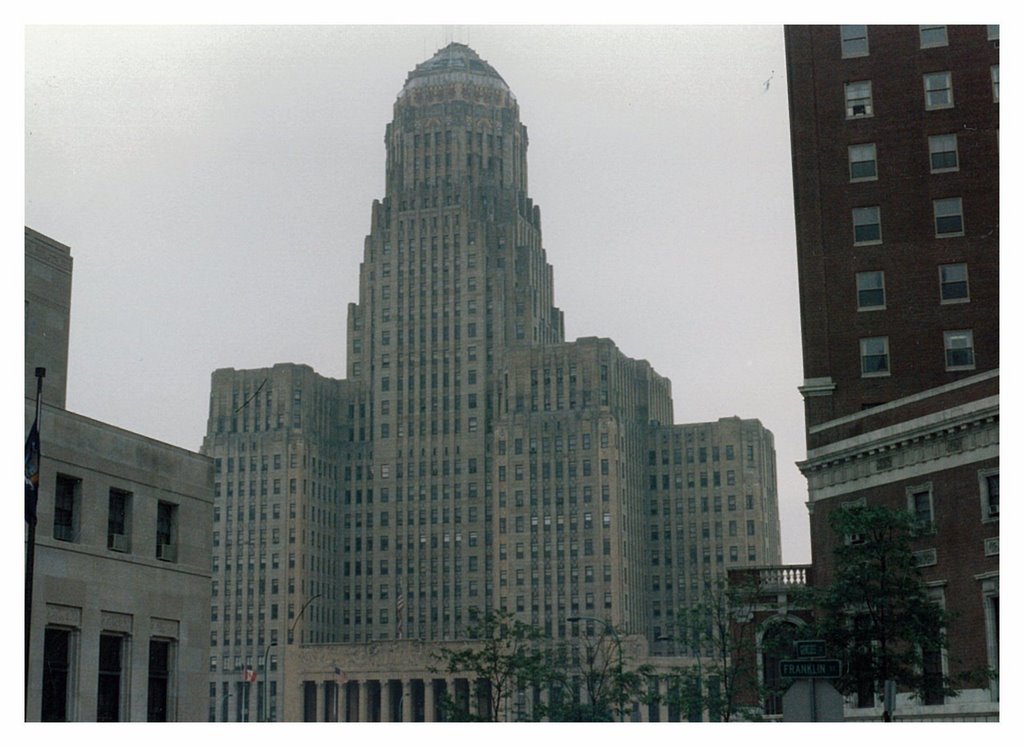
Buffalo City Hall is one of the best examples of the architectural style, known as Art Deco. We have seen Buffalo City Hall, on the travel photo blog of North America:

http://photos1.blogger.com/blogger/5492/3756/1600/1.jpg

Not far from Buffalo City Hall is a building, known as the Guaranty Building, that was very important in the early development of skyscrapers:

https://en.wikipedia.org/wiki/Prudential_(Guaranty)_Building#/media/File:Prudential_Building_2013-09-08_12-21-41.jpg

The first of the following scenes of downtown Buffalo is from almost the same perspective as the above photo of City Hall, but with the obelisk known as the McKinley Monument visible. The McKinley Monument is in what is known as Niagara Square. The monument is in honor of U.S. President William McKinley, who was assassinated by an anarchist at the Pan American Exposition in Buffalo in 1901. The new president was sworn in in Buffalo. He was Theodore Roosevelt, whose distant relative Franklin D. Roosevelt would also later be a president from New York State.

https://www.google.com/maps/@42.8867236,-78.8772296,3a,75y,270h,90t/data=!3m7!1e1!3m5!1s4NjJPtFQFJ9F8Jp3-9Zldg!2e0!6s%2F%2Fgeo2.ggpht.com%2Fcbk%3Fpanoid%3D4NjJPtFQFJ9F8Jp3-9Zldg%26output%3Dthumbnail%26cb_client%3Dmaps_sv.tactile.gps%26thumb%3D2%26w%3D203%26h%3D100%26yaw%3D234.67265%26pitch%3D0!7i13312!8i6656

Here are some scenes around North Buffalo, starting in the library building at Buffalo State College. The building listed as the "Buffalo History Museum" is actually a structure left over from the Pan American Exposition, of 1901:

https://www.google.com/maps/@42.9337127,-78.8807937,3a,75y,67.72h,90t/data=!3m8!1e1!3m6!1sEFF2S4DTUjoAAAQo8THd8A!2e0!3e2!6s%2F%2Fgeo2.ggpht.com%2Fcbk%3Fpanoid%3DEFF2S4DTUjoAAAQo8THd8A%26output%3Dthumbnail%26cb_client%3Dmaps_sv.tactile.gps%26thumb%3D2%26w%3D203%26h%3D100%26yaw%3D65.250252%26pitch%3D0!7i13312!8i6656 

There is a lot more about the city of Buffalo in the posting, "All About Buffalo NY" May 2022.

Rock Music Era

On the subject of Cleveland today, where the Rock and Roll Hall of Fame is located, let's have a look at the era of Rock Music. These are just general observations.


I see the Rock Music era as lasting from the 1950s to around the new millennium, although that is open to definition. During the latter part of the era rock music had a lot of competition from other forms of music, particularly Rap. The peak of the Rock Music era was 1970-72, although it's heyday is generally considered as the 1960s.

The real challenge of Rock Music has got to be names. There were countless bands and innumerable songs. Every band and every song had to have a name that was different from every other. At first it must have been easy but as time went on it got more and more difficult.

The Rock Music era was the result of several factors converging. The first factor was demographic, the Baby Boomers born after the Second World War were reaching their teens and Rock Music was to be their anthem. Portable inexpensive transistor radios came along at just the right time, along with tape players and vinyl records. Young people having cars was a very important element of the Rock Music era. Finally it was a relatively prosperous time, although certainly not peaceful, there was no world war or economic depression. Young people mostly had the leisure to enjoy music.

Choosing the best song of the Rock Music era is impossible. A hundred different people may well make a hundred different choices. It cannot fairly be judged by record sales because changing demographics might be a factor, there might have been more people of the age demographic most likely to buy a record when one song was popular, as opposed to another. At one point in the Rock Music era a song might have sold more records because there was less competition from other popular songs. A song that became popular when economic times were good would have an advantage over one that became popular during a recession, because people would have had more money to buy the record.

Demographics is a clear factor in two music movements that emerged during the late 1970s. Disco and New Wave emerged at just about the time that the children of the first Baby Boomers were reaching their teens. They heard their parents listening to the new movement of Rock Music and now they had their own new movement. The music that came before Rock, such as Jazz, was more "nightclub" music than to listen to while at the beach or riding in the car. Disco went back to the nightclubs in that it was more about dancing than Rock was.

Rap music follows the same pattern. It is widely believed to have originated with the early 1980s Blondie song, "Rapture". This is just about the time that the children of the Baby Boomers, having grown up hearing their parents listening to Rock and Motown music, were ready to start their own style of music.

The ultimate ancestor of Rock songs are the Psalms in the Bible, but the songs are usually about romance rather than God.

I have a spiritual theory about the 1960s, generally considered as the heyday of Rock Music. Jesus foretold that the countdown to His Return to establish His Kingdom on earth begins when the original city of Jerusalem comes back under Jewish control after a long time of being ruled by Gentiles. This occurred in 1967, with the Six-Day War. This means that there will be people alive when His Kingdom is established that were alive when Jerusalem came back under Jewish control, Jesus said that in the first three Gospels. But the nation of Israel had been reestablished in 1948, nineteen years before Jerusalem came back under Jewish control. The Tribulation Period, the worst time the world will ever see, has to happen before Jesus' Return. The world will put it's faith in the Antichrist but he will be unable to save them from the Tribulation. The Baby Boomers inherited a world that had recently seen world war, genocide and, economic collapse. My theory is that the nineteen year delay before Jerusalem came back under Jewish control was to give this idealistic new generation a chance to build the Millennial Kingdom themselves, without going through the Tribulation Period. It was only when God saw that it wasn't going to work because we were just too sinful that the countdown moved forward with Jerusalem.

The idealism of the 1960s really showed at Woodstock, in 1969. 400,000 young people got together for three days and there was not a single act of violence.

The Temple Mount and other holy sites in Israel became much more open to pilgrims in 1967. Maybe God was hoping that this idealistic new generation would find Him, it might even be possible to avoid going through the Tribulation Period before the Millennium, instead of finding drugs along the Hippie Trail and at Woodstock.

Rock Music can, of course, be dangerous. Charles Manson believed that the Beatles' White Album was especially communicating with him. His "family" committed horrific murders of white people in Los Angeles in order to make it appear that black militants had done it, which would start the race war that he believed would be Armageddon and would conclude with him ruling over the world as Christ.

There is much more on my spiritual perspective on the Rock Music era and the 1960s in the compound posting on this blog, "The Aztec Prophecy" April 2018.

Our Language

This is being reposted because much more is being added on to it.

I periodically collect postings about similar subject matter together into a compound posting. This new compound posting is about our language. The compound postings are listed in the introductory posting at the top, "Introduction To This Blog System". Some compound postings are about science and some are about the world and human issues. Use the search utility in the upper left of the screen to bring up the listed compound postings.

TABLE OF CONTENTS

1) OUR CONFUSING LANGUAGE

2) MISSING WORDS

3) THE STORY OF THE ENGLISH LANGUAGE

4) THE ROOTS OF ABBREVIATION

5) THE PARADOX OF WORDS

6) THE BATTLE OF THE ALPHABETICAL ORDERS

7) HAMPTON COURT PALACE AND THE KING JAMES BIBLE


1) OUR CONFUSING LANGUAGE

Today I would like to express sympathy to anyone who is learning to speak English.

The first thing that is confusing is that the same letter, "s", is used for both the possessive and the plural. You just have to remember that if there is an apostrophe between the word and the "s" it is possessive, if not it is plural. Some words have plurals, "trees" but some don't, "fish", there is no pattern so you just have to remember.

"Go" is a very-often used word. If we have already left then the past tense is "gone". The present tense is "going". But if the journey is already completed it becomes a completely different word, "went", that has no apparent connection to forms of "go".

There is a clear connection between the words, "affect" and "effect". The first is a verb and the second is a noun. Using the same logic it would appear that there is also a connection between "principle" and "principal", but the two words have nothing to do with each other and mean completely different things.

Then there are words with more than one meaning. "Like" means "similar to" but also "to have affection for". "Does" is the present tense of "to do" but, with a different pronunciation, is also plural female deer. "Mine" is a possessive, an underground excavation from which minerals are extracted and also, a hidden explosive device.

A scenic road that runs through or along a park is often called a "parkway". "To park" also means to bring a vehicle to a stationary position. Homes and businesses have places for vehicles to drive into, before parking, called "driveways". The bizarre result is that we drive on a parkway but park on a driveway.

There are words that sound the same but have different completely meanings. There are "steel" and "steal", "spear" and "sphere" and "scene" and "seen". There are words that look like they should rhyme but they don't, "rough", "cough", "dough" and, "plough"

A word that I found confusing is "delight". "Decompress" means to take away compression. The prefix "de-" means to take away something. So "delight" should mean "to turn off the lights", instead of being pleased or happy.

Even if words all made sense, sentences can be confusing. "I got on the bus and went to my assigned position". But what does that mean exactly? Does it mean that they went to their assigned seat on the bus, or does it mean that they rode the bus to their assigned position in the city?

THE CHEMISTRY CONUNDRUM

One of the best examples of how confusing our language can be is what I call "The Chemistry Conundrum".

There is something about basic chemistry that is confusing and doesn't make sense. It concerns valence, or the exchange of electrons between atoms to form molecules.

There are two electric charges, negative and positive. But negative and positive are represented by the symbols "-" and "+". The confusion begins because these two symbols also have another meaning.

Minus, "-", means to subtract or take away. This is the same symbol that is used for negative electric charge.

Plus, "+", means to add or join to. This is the same symbol that is used for positive electric charge.

There are two types of bonds between atoms so that they form compounds or molecules. Ionic bonds are where one atom loses an electron to another so that one atom has a net negative charge and the other has a net positive charge, so that they join together by mutual opposite charge attraction. Covalent bonds, in structures such as the complex structures of carbon atoms, is where two atoms share one or more electrons.

Ionic bonds are more in inanimate matter but the molecular bonds in living things rely on covalent bonds. As you can see by your flesh, matter based on covalent bonds is often flexible while ionic bonds tend to be brittle or inflexible.

This conundrum concerns ionic bonds. Suppose that two atoms are close together and one takes an outer electron from the other. Because electrons have a negative charge, the atom that loses the electron will then have a net positive charge. The atom that gains the electron will then have a net negative charge.

Do you see how confusing this is?

An atom loses an electron which has a negative charge, as in "-", yet it now has a positive charge, as in "+", as if it has gained something because "+" also means addition.

The other atom gains the electron. To gain means to add something. Addition is symbolized by the plus sign, "+", but the atom now has a negative charge, which is symbolized by the opposite sign, "-".

The negative and positive designations given to the two opposite electric charges are entirely arbitrary. We could just as easily called negative positive and vice versa. If we said that the electron has a positive charge, while the nucleus has a negative charge, which is now what we define as antimatter, it would make more sense.

An atom that GAINED an electron would then have a POSITIVE electric charge, as in "+".

An atom that LOST an electron would then have a NEGATIVE electric charge, as in "-".

Wouldn't that make more sense and be less confusing?

2) MISSING WORDS

Has anyone ever wondered if there are things that we don't have words for? Technology and society are always progressing and so there is a continuous flow of new words. But that is not what I mean. What I mean is things that we have always had with us but never gotten around to assigning a word to, at least in our language.

It is sometimes said that love and hate are not really opposites but are more like "flip sides of the same coin". When we have strong feelings for someone or something those feelings may be manifested as either love or hate. But that doesn't make the two opposites. They are both at one end of the scale. The opposite of either love or hate is indifference.

Religious people know that the furthest person from God is not one who hates God or religion. We have to have some regard for something before we can hate it. The furthest person from God is one who is just indifferent, not interested. Furthermore love and hate can be mixed together, as in a "love-hate relationship". So it is not accurate to describe love and hate as opposites.

How about the relationship between salt and pepper? The two are found together, in shakers or dispensers at restaurants. But yet the two cannot be described as opposites. One may use both salt and pepper. The word "pair" isn't quite right either. A pair is two things that always go together. Salt and pepper are usually offered together but yet cannot really be described as a "pair" because one can use one or the other, or both, or neither.

A similar example is the relationship between tea and coffee. The two are often offered together but are more exclusive than salt and pepper. Unlike salt and pepper one gets either tea or coffee but not both, so describing them as a "pair" fits even less than with salt and pepper. But neither can the two be described as "opposites" because they have so much in common, a hot brewed drink, and are often offered together and served in a similar way.

The truth is that these three relationships represents a missing word, something that we never assigned a word to. Two words that might come close are "pair" and "opposites", but neither quite fits the relationship between love and hate, between salt and pepper, and between tea and coffee.

The closest we come to describing these relationships is the phrase "like flip sides of the same coin", which is somewhere between opposites and a pair. This is one example of something that never got a word assigned to it.

Sometimes words get left behind from one place to another. A British word that I notice Americans don't use is "crumple". When something collapses and it's components come apart, as with a concrete structure, it "crumbles", with a "b". When something collapses and it's components stay joined together, as with a sheet of paper, it "crumples", with a "p".

3) THE STORY OF THE ENGLISH LANGUAGE

The reason that the English language is suitable to be the global language that it is today is that it has such a wide "span" of words, in comparison with most other languages. This makes it easy for foreign words to be readily adapted into English.

To understand how this came about, we must go far back into history. English is basically a northern European, or Germanic, language. The structure of the language is similar to that of German, Dutch, Danish, Norwegian and, Swedish. A close correspondence can be seen between many English words and their counterparts in German, for example. There is I and Ich, water and wasser, house and haus, Friday and Freitag.

But the English language underwent a special event that transformed it by greatly broadening it's span of words and sounds. There are two basic language groups in western Europe, the Germanic languages in the north and the Romance languages around the Mediterranean area. Romance languages include Italian, Spanish, Portuguese, French, Catalan (spoken in the area around Barcelona) and, Romanian. What is now England turned out to be the frontier where the two would meet.

England was originally a part of the Roman Empire. But it is one of the few areas of Roman occupation in Europe that did not end up speaking a Latin-based Romance language. England was later settled by Anglo-Saxons, from what is now Germany, and also Danes and Vikings. This was the beginning of English as a northern European language.

The critical event in shaping the language that we have today was, in my view, the landing of a group of Vikings, known as Normans, in what is now Normandy on the north coast of France. The Normans established a kingdom and adopted the French language. Later they crossed the English Channel, into what is now England, and brought their language with them.

English remained a northern European language in it's structure. But the mixing in of the Normans, and their language, introduced a flood of French words. This would make English almost as much a Romance language as a northern European one. In many cases, new words from French would displace the older Germanic words. As one example, English uses the French "place" instead of a variation of the German "stadt".

You may wonder what real difference this makes, whether we say "place" or "stadt". But it is this influx of new words from a foreign language group that gave English the very wide span that it has today, and this is what gives it the adaptability to be a global language. It readily adapts words from all over the world, just as it once did French words from the Normans.

Most of the new words were changed in pronounciation, or spelling, or both. The French language itself had earlier undergone a similar process. French is classified as a Romance language, descended from the Latin of the Romans and related to Spanish, Portuguese and, Italian. But the Celts were very prominent in France and a lot of their words were absorbed into the language.

This is a fairly common occurence, a language being spread by conquest but then being changed by absorption of local words. Mexican Spanish differs from that of Spain because of the inclusion of so many native Indian words.

I spent a few days keeping a list of all the words I coult think of that seemed to be of French origin or influence. So many of the words that we use everyday have a very French appearance, even though these words may not be used any more, or were never used, in French: active, avenue, beautiful, boutique, bureau, carousel, cataract, chandelier, change, complete, dentist, depot, economy, enroute, envelope, equal, finish, force, glorious, individual, office, origin, palisade, persevere, pharmacy, entreat, precise, provide, route, sequence, service, severe, spontaneous, tour, treasure, unique, venue.

Some French words are still pronounced the same in English, such as depot and debut. Others have has their endings anglicized from -ie to -y, such as economie to economy, -eur to -or, -aire to -ary, such as documentaire to documentary and, -ique to-ic, such as electronique to electronic. The common -aux and -eux endings in French are rarely seen in English.

French words are often formed from a "mix-and match" selection of prefixes and suffixes. A good example is the word "constellation", an arrangement of stars. The word "stellar" means something to do with stars. The prefix con- means "put together", as in construction. The suffix -tion means "a manifestation of something" so that a constellation is a manifestation of an arranging of stars.

The French language is, like English, not always as precise as this. Induction and capacitance are two French words for related concepts in electronics. But one uses the -tion suffix and the other uses the -ance suffix.

Intend and extend are also French words that seem as if they should be opposites. But the two apparently related words actually have nothing to do with each other, to intend is to plan something and to extend is to lengthen something.

The most common French influence on English is probably the -tion, or -ion, ending. It simply means a manifestation of something. The list is nearly endless: addition, communication, compensation, conclusion, concussion, conduction, confirmation, construction, contraption, deception, definition, destruction, division, edification, edition, education, induction, information, institution, instruction, introduction, nation, obstruction, occupation, pension, perfection, position, probation, provision, subtraction, vacation, validation, vibration, vision, vocation.

Then there is the French -ment ending: basement, confinement, escarpment, employment, government, ointment, parliament, replacement, retirement, treatment. This -ment ending is somewhat more focused than the -tion ending, and usually means a place or thing or method that does something. A government is that which governs and a basement is that which acts as a base.

Then there is the -age ending: adage, advantage, beverage, encourage, entourage, language, mortgage, village and, voyage. The -age ending is similar in meaning to -ment. An entourage, for example, is those that are all around one.

The -ance ending falls into the same pattern of something that does something: capacitance, distance, entrance, finance, insurance, renaissance, resistance, resonance.

Notice that these various endings are of the same pattern as common French verbs. There are the verbs in French ending with -er, those ending with -re, and those ending with -ir.

Some French words in English end with -ant: brilliant, enchant, important, infant, restaurant, servant.

Other end with -ate: estate, exaggerate, illuminate. There is altitude, attitude and, gratitude. There is lovable, portable and, soluble. There is also interest and modest. There is defense and offense, content and patent and patient, frontier and cavalier, mortician and politician.

Even if some of these are not French words, they still show the tremendous influence of the patterns in French on English and how it gave it the wide span of the global language that it is today.

Then there is the prefixes, or beginnings of words, from French.

The in- prefix is often seen: incomplete, influence, information, inspection, institution, instruction, insurance, interest. The prefix inter- means between, such as intermission or international.

Examples of the con- prefix are: conduction, confinement, congruent, consolidate, continuation, control, construction.

There is the ex- prefix: exaggerate, exchange, exhibition, explain.

Then there is the French en- prefix: enchant, encourage, enlighten.

The de- prefix means to undo something. Decode means to undo a code. Perception is to see something, deception is to prevent from seeing something. But there is also deficient, definition and, deliver.

The dis- prefix is similar in meaning: discontinue, discourage, disengage.

Re- is generally the opposite of de-: reconnaissance, renaissance, replace, report, request, reverse.

There is pro-: produce, pronounce, provide.

Com- means to put together: combination, compare, compensation, compile.

Pre- means before: precede, prefer, previous.

Even though cars were developed long after the time of the Normans, the subject of cars is especially loaded with French words: alternator, automobile, carburetor, chassis, chauffeur, coupe, exhaust, garage, gasoline, limousine, lubrication, sedan, transmission.

Now, you can see how much the French language has influenced English. It is the grafting of all of these French and French-influenced words onto the northern European structure of English that has given it the broad span that makes it suitable to be the global language that it is today.

4) THE ROOTS OF ABBREVIATION

Our language got the wide span of words, that makes it suitable to be the global language of today, by being basically a Germanic language but then having French words added after the Norman Invasion. What I would like to add to that is how the French-influenced words in the language are far more likely to be the words which are commonly abbreviated. This is simply because these added words were originally alien, and abbreviation was a way of adapting them.

Words of Germanic origin are almost never abbreviated. These are words that can be seen as similar to their counterparts in other northern European languages, such as drink, house, water and, school. This is not a strict rule because "street" is abbreviated as st. and "near" is sometimes abbreviated as nr. and both of these words are of northern European Germanic origin.

French-influenced words commonly use prefixes, such as con-, or suffixes, such as -tion. Some English words have their roots in French clearly seen, such as the word "donate" from the French "donner", meaning "to give". Almost all French words have had their pronunciations anglicized. The first exceptions that I can think of are the words "depot" and "debut".

Two words that illustrate the French way of forming words involves the prefix con-, meaning to put together, and the suffix -tion. Construction means the putting together of a structure. Stellar means something to do with stars, and so constellation means a group of stars that have been put together.
Here is a list of the words that I can think of which are commonly abbreviated. Every one is a word of French origin or form:

Abbr. for abbreviation
Amp. for ampere
Auto for automobile
Ave. for avenue
Avg. for average
Co. for company
Comps. for comparables (in real estate)
Const. for constant
Cont. for continued
Corp. for corporation
Dept. for department
Dist. for distance
Ed. for education
Esq. for esquire
Est. for established
Expo for exposition
Ext. for extension
Freq. for frequency
Gen. for generation
Govt. for government
Info for information
Ins. for insurance
Inst. for institution
Intel for intelligence
Max for maximum
Mfg. for manufacture
Min. for minimum
Neg. for negative
Org. for organization
Pos. for positive
Pres. for pressure
Prop. for propulsion or propellor
Req. for require
Spec. for specifications
St. for saint
Tel for telephone
Temp. for temperature
Var. for variable

Notice how French-sounding all of these words are, and most are the same or similar to their French counterparts. It is very likely that, if English was originally a Romance language and northern European Germanic words were added later, the pattern would be reversed and it would be those words which would be abbreviated today.

5) THE PARADOX OF WORDS

Language developed early in the history of humans. There are many different languages but the world uses the same number system.

Suppose that we suddenly forgot all spoken and written languages and had to develop them again, but would still know what we know now. My conclusion is that we wouldn't even need words, we could express everything with numbers.

The way I see it to express something in numbers we must completely understand it. Numbers are to express what we completely understand while words can express what we only partially understand. An example is the calendar, we couldn't have a numerical system of dates without completely understanding how the calendar works.

I have written on this blog before about a theoretical future "K-Day". The "K" stands for "knowledge", for the day when we will know all that we can practically know. As we progressively gain a more complete understanding of what we know, as time goes on we should be expressing a higher proportion of information in numbers, rather than in words. K-Day is the future day when we can express everything in numbers, and will no longer need words.

My conclusion is that, while we haven't yet reached K-Day, if language was suddenly forgotten and we had to develop it anew, the focus would be on numbers and the use of words would go out of style. I believe that today we are only using words as much as we do because of historical momentum.

Numbers can be interconnected much more easily than words can. Numbering something relative to other numbers can define it much better than any words can. Let's start with the elements of the Periodic Table, since all of the matter that we deal with is made of atoms. The elements are numbered by the number of protons in the nucleus.

These atomic numbers describe the operation of atoms far more efficiently than the names of the elements do. The atomic numbers can be combined together, as atoms combine into molecules and compounds, so that any material can be conveniently expressed by numbers.

The only reason that the elements of the Periodic Table, such as oxygen, iron and, gold have names is because humans were using them long before atoms were understood. If we had to develop language over again using the names of the elements would make no sense at all.

We have already numbered every shade of color and are always using part and model numbers. Why couldn't we number the parts of the body, and each subpart, as well as all activities which involved that body part? That would actually be a lot easier than assigning words.

We could number geological features and all processes of nature, from cloud formation to ocean currents, could be described by numbers.

Remember that numbers are to express what we completely understand while words are for what we only partially understand. Humans developed words for so many things because they did not understand what we know now about them. These things could now be expressed with numbers that can convey a lot more information than the words can.

Today we could make a numerical tree of all living things that was nowhere near understood when the words developed to describe them.

We already extensively use model and part numbers. Everything from the types of and general parts of homes and buildings to the parts of and types of vehicles could be expressed much better with numbers than with words, because it is easier to compare parts with relative numbers.

Since we now know so much about human history we could number the nations in a settlement tree. Within each nation the cities could be numbered in a sub settlement tree.

People today in virtually all nations have some kind of identifying numbers. Why couldn't we just identify primarily with numbers instead of with names? 

Numbers would be far more efficient especially considering what I refer to as the "Name Crunch". The world's population has greatly increased but we are still identifying people with the same names as centuries ago. What good is it to try to find someone online when there might be thousands of people with the same name?

A person's number could be based on their body type, the year of their birth, and their ethnicity or the place that they were from. It would be so that one could guess approximately what someone's identifying number would be. Or, having an identifying number and seeing a group of people, select the person whose number it likely was.

Now that we have as much knowledge as we do numbers could convey far more information than words. Since our number system is global there is no need to translate numbers from one language to another. The only reason that we use words as much as we do is historical momentum. I am sure that if all languages were suddenly forgotten, and we had to develop them over again, we would use primarily numbers.

6) THE BATTLE OF THE ALPHABETICAL ORDERS

Here is something that I wonder if anyone else is thinking about. How much longer are keyboards going to be in the Qwerty order? Wouldn't it be much better to just be in the ABC order?

The reason that the letter keys on a keyboard are not arranged in the same order as the letters of the alphabet is that secretaries, in the days of typewriters, used to have to be able to type fast. Secretaries began typing with their fingertips resting on keys in the middle row. The central two keys were between the secretary's index fingers on opposite hands.

Some letters of the alphabet were used more than others. The Qwerty keyboard was designed so that the letters of the alphabet that were used the most were easiest to reach. The objective was for the secretary to be able to type as quickly as possible.

But those days are gone. It used to be that relatively few people could type, mostly secretaries, reporters and, writers. Those had training in typing.

Today everybody types. But there is a difference between typing and writing. Secretaries were not writers. In most cases they didn't have to do much thinking. They were either taking down spoken words or consolidating written documents. Secretaries didn't produce the content that they were taking down.

What virtually everyone who uses a keyboard does today is writing, as opposed to just typing. Users of keyboards today are almost always producing the written content, rather than just taking it down. The difference that makes is that pure speed is not as important. It doesn't do writers any good to be able to type faster than they can think.

The use of secretaries, whose strength is pure typing speed, has greatly diminished. The vast majority of people today do their own writing, in which speed is not as much a factor as in pure typing because it is of no use for a writer to be able to type faster than they can think.

So the way the alphabet has been skewed into this Qwerty form, so that trained typists can type as fast as possible, is no longer necessary. It would be much easier for untrained typists to write as quickly as practical if the letters of the alphabet were in the traditional ABC order that everyone is familiar with.

I know that I would prefer the ABC order when I am doing my writing here. Imagine someone learning to speak English learning the letters of the alphabet, but then being presented with a keyboard that has the letters in a completely different order. Every culture has things that seem strange to outsiders, and this is certainly one of our things.

This is an ideal example of how we tend to get technically forward but system backward. We make so much progress in technology but we are basing it on an underlying system that has been in use for decades. A prominent example of this is the ASCII system of computer encoding that we saw in the recent compound posting, "Computer Science".

There is another possibility, if we look at this from another angle. Most people use this Qwerty order of the alphabet much more than they use the traditional ABC. This might be one of those gradual changes that we scarcely realize is taking place. Maybe Qwerty is effectively becoming the new order of the alphabet.

We do not have to make a sudden decision as to which order of the alphabet will predominate. Things like this take time to sort themselves out. There really isn't anyone with the authority to decide which alphabetical order will win out.

We know that words and spellings change over time, why not the order of the alphabet? Modern signage and communication technology is already making changes, such as "night" being shortened to "nite". Texting is changing "you" to "u", which would work because it is the Dutch word for "you".

When is either a phone or computer company going to market a keyboard in the traditional ABC order, indicating that the Qwerty order is going away, or someone who makes lists in alphabetical order going to list them in the Qwerty order, indicating that the Qwerty order is taking over? This will give us an indication of which direction this is going to go.

Is there anyone who can recite the Qwerty order, without looking at a keyboard, other than the first six? Depending on which direction this goes, maybe it might be a good idea to start learning it.

QWERTYUIOPASDFGHJKLZXCVBNM

TWO ALPHABETICAL ORDERS MAKE ENCODING EASY

The two alphabetical orders do offer a wonderful opportunity to encode a document so that it will look like gibberish to anyone who doesn't know what the code is.

Most simply the ABC order would be superimposed on the Qwerty order so that A = Q, B = W, and so on. But that might be too obvious. Maybe the ABC alphabet could start at the A on the Qwerty alphabet so that A = A, S = B, and so on.

We could reverse the above example so that the real alphabet of the document is the Qwerty alphabetical order, and the encoding is in the ABC order. Because the alphabetical order doesn't matter in writing.

To get even more confusing for anyone trying to decode our message we could have the alphabetical order of the ABC alphabet but could start the alphabet from a letter other than A, as described in the example above. Because, again, the alphabetical order doesn't matter in the reading of a document or message.

If we were dealing with immediate messages, rather than permanent documents, the possibilities of encoding by using the two alphabetical orders would be endless. 

The ABC alphabet could begin on the first letter of the day of the week on the Qwerty keyboard. Maybe we could reverse it, as described above by making the ABC the encoding order and the Qwerty the "real" order, if the date in the month is an odd number but not reverse it if it is an even number.

To make this encoding really effective we would have to include punctuation, periods, paragraph breaks and spaces, in the alphabets so that anyone trying to decode it wouldn't be able to tell how many letters are in each word. If not the decoder might be able to pick out "a" and "the", which would provide clues on how to decode it.

7) HAMPTON COURT PALACE AND THE KING JAMES BIBLE

The King James Bible, first published in 1611, has had an incalculable effect on the English language, particularly the long list of "King James Idioms".

Hampton Court Palace, on the southwestern edge of London, is another of the red brick palaces built by Henry VIII (The Eighth). The other remaining example of these palaces is St. James, in central London. Henry VIII had three children that reigned after him, Edward VI, Mary I and, Elizabeth I. Henry VIII had broken with the Catholic Church, bringing England onto the Protestant side during the Reformation.

The Reformation, a consequence of the Renaissance, was brought about by original versions of the Bible becoming available in the west. Scholars had moved west, carrying many ancient texts with them, when the Byzantine Empire was conquered by the Ottomans. New translations of the Bible appeared regularly as the invention of the printing press ensured that anyone could now read the Bible for themselves, in their own language.

John Wycliffe, sometimes referred to as "The Morning Star of the Reformation", was the first to translate the Bible into English, in handwritten form before the development of the printing press. William Tyndale translated the first English printed version, but did not translate the entire Bible.

There appeared the Coverdale Bible, the Matthews Bible, the Great Bible, the Geneva Bible and, the Bishops Bible. The competition between versions of the Bible revolved around not so much the words of the Bible itself as the margin notes that were added to the Bible.

Henry VIII's daughter, Mary I, tried to bring England back to Catholicism by force. Puritans set up a printing operation in exile in Geneva, and introduced the very popular Geneva Bible, sometimes referred to as the "Breeches Bible".

After Mary I died another daughter of Henry VIII, Elizabeth I, became queen and restored the Reformation while trying to bring peace by compromise with Catholics. The result was the Anglican Church and the Bishops Bible. We can see today how the Anglican Church was the result of such an attempt at Puritan-Catholic compromise in how it still tends to be divided into a "high church", representing the Catholic side, and a "low church", representing the Puritan side.

The Bishops Bible was Elizabeth I's Anglican Bible. But it never gained popular acceptance. The few remaining copies of the Bishops Bible seem to have barely been used.

Elizabeth I was the last of the House of Tudor. She was followed by the first Stuart King, James I. The Puritans, in disagreement with the Anglican Church because they wanted no compromise at all with Catholicism, hoped that James I would listen to them. He did, although he did not sympathize with the Puritans as much as they had hoped. But James I did agree that a new Bible was called for.

A conference was held and teams of scholars were appointed for the necessary translation of the Bible. It was reminiscent of the Septuagint, when the Hebrew Scriptures was translated into Greek for the Jewish community in Alexandria, many of whom were forgetting how to speak Hebrew. The conference took place at a palace that had been built by Henry VIII, Hampton Court Palace. Ironically, the palace was originally intended for a cardinal, but that was changed upon arrival of the Reformation.

The result was the publication, in 1611, of the King James or Authorized version of the Bible. Most of the phrases of William Tyndale, in the parts of the Bible that he translated, were retained in the King James Version. This is the familiar old Bible with the archaic wording such as "thee" and "thou". In 1769, another edition standardized spelling and punctuation.

The King James Bible was not an immediate success. It was decades before it replaced the Geneva Bible, and was plagued with printing errors in it's early days. But the Geneva Bible was considered as the Bible of the Puritans and when they fell increasingly out of favor, the King James Bible took over because it was seen as the Bible of reconciliation.

This is the most printed book ever, in the English language. It was by far the dominant English-language Bible for at least 250 years, from 1700-1950 when versions in "modern" language began to be printed. The King James Bible had more influence on the language than Shakespeare did. Even today, there is a "King James Only" movement in Christianity, that will only use the King James Bible.

My first Bible, that I used to take to school when there was psalm-reading there, was a King James Version (often abbreviated as KJV). Years later, when I started to really study the Bible for myself, it was with another King James Version.

There are over 200 of what are referred to as King James Idioms. These are phrases that were introduced into the language by the King James Bible, and are all around us today. Here is a list of some of these phrases, that most people use without having any idea of how they got into the language. 


https://www.theguardian.com/culture/2011/feb/18/phrases-king-james-bible

Here is Hampton Court Palace, where the conference that led to the King James Bible was held.

There are multiple scenes following. To see the scenes, after the first one, you must first click the up arrow, ^, before you can move on to the next scene by clicking the right or forward arrow, >. After clicking the up arrow you can then hide the previews of successive scenes, if you wish.

https://www.google.com/maps/@51.4038758,-0.3387258,3a,75y,73.93h,90t/data=!3m8!1e1!3m6!1s-c2uSBhxiXzU%2FUnZtr-WEx2I%2FAAAAAAAABEU%2Fb3spqcjswRs_tDn8qreLutGufoESAimOw!2e4!3e11!6s%2F%2Flh5.googleusercontent.com%2F-c2uSBhxiXzU%2FUnZtr-WEx2I%2FAAAAAAAABEU%2Fb3spqcjswRs_tDn8qreLutGufoESAimOw%2Fw250-h100-n-k-no%2F!7i4264!8i1700


If you want to write see, "The Art Of Writing", on the world and economics blog:

www.markmeekeconomics.blogspot.com/2014/01/the-art-of-writing.html?m=0