Thursday, September 14, 2023

The Final Vote For Salvador Allende

This week was the fiftieth anniversary of what is known as "America's Other 9/11". September 11, 1973 was when the coup took place in Chile that had been encouraged and promoted by Richard Nixon and Henry Kissinger. The Chilean military bombed and attacked the presidential palace in Santiago. The president of the country, Salvador Allende, was killed.

We saw Henry Kissinger in "Henry Kissinger At 100", June 2023.

What Nixon and Kissinger had against Allende was that he was a Communist. He had been legitimately elected but this was the height of the Cold War, Cuba and the Missile Crisis was still fresh in memory and Nixon was determined to keep Communism out of the western hemisphere. His administration did all it could to make it difficult for Allende to govern, until he was finally overthrown and killed in the coup.

The trouble was what came next in Chile. A right wing president came into power, Augusto Pinochet. The general consensus is that his rule was oppressive and dictatorial, although he did have a limited number of admirers. The Nixon Administration, of course, supported him but later U.S. administrations turned against him. Pinochet was finally removed from office although he never faced trial for crimes of oppression.

A division has remained in Chile over Allende against Pinochet. Allende is certainly the more popular of the two now and his statue stands adjacent to the presidential palace in Santiago. Image from Google Street View.


There is something that I have never seen written about the division involving Allende and Pinochet, and I think it can be considered as the final vote for Allende. I am no Communist myself but Chile is another country and it up to the people of that country to vote for what they want.

In 2010 the world watched while 33 miners in Chile were rescued who had been trapped far underground by a mine collapse. All of the miners were successfully rescued.

The world's attention was on the miners. Then came what I consider as the final vote for Salvador Allende. The miners pledged that all of the money earned from their sudden fame would go into a common pot that they would share equally. This was an act of pure Communism that would have made Salvador Allende smile.

The Danger Of Fusion Ignition

There is a popular movie about J. Robert Oppenheimer, the developer of the atomic bomb. When nuclear weapons were first being developed there were all kinds of fears. Few people really understood the technology and it was something that humans had never dealt with before.

Do Indians know that J. Robert Oppenheimer could speak Sanskrit and quoted the Hindu scriptures after the first nuclear test?

When the first nuclear test took place how did we know that it wouldn't ignite the atmosphere? The nuclear process might continue into the atoms composing the atmosphere. Of course that would be the end of life on earth.

Every once in a while there was a supernova, an exploding star, in the sky. Maybe the upcoming nuclear test would be the spark that would cause the atoms of the earth to ignite and share a similar fate.

What about all the stars in the sky? They were in a state of ignition. How did we know that a nuclear explosion wouldn't be the detonator that would make the earth into a star?

Such fears turned out to be unfounded. The nuclear process was based on fission, the splitting apart of atoms, which released energy. But only a very limited number of atoms can undergo fusion. The 235 isotope of uranium is only about one out of every 140 uranium atoms, which must be separated from the non-fissionable 238 isotope. Plutonium, which is a man-made element from uranium, but is very difficult to produce, can also undergo fission. The atoms of oxygen and nitrogen in the atmosphere cannot possibly undergo fission.

As for stars they are not based on fission but on fusion, which is the opposite nuclear process. Any atom can undergo fusion but the mutually repulsive negative charge of the electrons on the outside of atoms causes the atoms to resist being fused together. It takes either a tremendous amount of energy, such as that released in the Big Bang or a supernova, or a tremendous amount of gravitational force to overcome this mutual repulsion of the outer electrons in atoms. When enough mass gets collected together to provide this gravitational force the masses will ignite by fusion and is known as a star. The earth has nowhere remotely near enough mass to undergo such ignition.

Older nuclear technology is based on fission. But now we are closing in on getting energy from fusion. The energy obtained will be much greater, any atoms can be used as fuel, and it will produce no radioactive waste. I am not claiming that it is going to happen, but if you would like something to worry about such ignition of the atmosphere and earth is much more likely to happen with fusion than with fission.

Present nuclear power comes from fission, splitting the atoms of a certain isotope of uranium. But nuclear power, as we have it now, had a downside. It creates wastes that will remain dangerously radioactive for centuries, and it is vulnerable to meltdowns and other accidents. It also requires the scarce and expensive 235 isotope of uranium or man-made plutonium for fuel.

The highest-profile nuclear disasters have been Three Mile Island, in Pennsylvania, Chernobyl, in Ukraine, and Fukushima, in Japan. The Fukushima disaster was caused by a tsunami. "The China Syndrome" was a 1979 movie about the meltdown of a nuclear reactor. The movie was so-called because the super-hot reactor core might burn it's way right through the earth and emerge in China.

Getting nuclear power from fusion, rather than this messy fission process, will supposedly do away with all that. Fusion means combining atoms together, rather than splitting them apart, and is the process that takes place in stars including the sun. Both processes release energy, fusion far more, and any material can theoretically be used in the fusion process. The fusion process produces no dangerous radioactive wastes.

Part of the problem with nuclear energy is that it's early proponents made too many promises. Energy would be so inexpensive that we wouldn't even bother metering it. When that never became reality it made nuclear power look like somewhat of a failure, even though it really isn't.

But here we go again with the development of fusion. Pretty soon we will live in a fusion wonderland. All of the energy that we could possibly need will be produced cleanly and efficiently. Along with electric vehicles this will save the environment, and we will all live happily ever after.

The trouble is that we will be dealing with temperatures and energies that we have never dealt with before. That is the great challenge of fusion, how to contain the process. We are replicating the process that goes on in the center of the sun and no material on earth can withstand it. Before combining into larger atoms the original atoms first come apart into a state of matter called plasma. The approach is to suspend the process in a magnetic field. The most common device for accomplishing this is called a Tokamak.

When the first nuclear bomb was detonated, in New Mexico in 1945, no one knew exactly what was going to happen simply because there had never been a known nuclear explosion on earth before. Some people were worried that it might cause the atmosphere to ignite. But the test went as planned and nothing of the kind happened.

But today we keep reading reports that we are getting closer to making nuclear fusion, as opposed to fission, into a practical source of energy, and I think we should take another look at this concern.

Nuclear fusion is what forms all elements, other than the hydrogen and helium and traces of lithium that formed in the Big Bang. Atoms are usually kept separate from one another because the negative electric charges of their outermost electrons mutually repel. But when enough matter is brought together by it's common gravity the pressure at the center of the mass is enough to overcome this mutual repulsion and crunch smaller atoms together into larger ones. 

All mass contains a certain amount of internal energy, known as the Mass-Energy Equivalence. But when atoms are crunched together like this the new larger atom contains less internal energy than the smaller atoms that formed it. This excess energy is released as radiation. 

The volume of mass that has enough force, by it's mutual gravity, to crunch smaller atoms into larger ones is known as a star, and the release of the excess energy is why stars shine. The energy released adds to the heat inside the star and it is this tremendous heat and pressure that continues the fusion process. Our sun is presently at the stage of fusing four hydrogen atoms into one helium atom, but it contains heavier elements because it is a second-generation star.

Fusion is the crunching of small atoms into larger ones, usually by the tremendous heat and pressure in the centers of stars. The opposite process is fission, the splitting of large atoms usually by high-speed neutrons. Both processes release energy, but fusion releases far more energy per mass. 

All of the nuclear energy that we use at the present time is from fission, the splitting of either the 235 isotope of uranium or plutonium. Efforts have been going on for a long time to get energy from fusion. We can fuse smaller atoms together into larger ones, one way is by using lasers, but, as of this writing, no one has yet made fusion into a net source of energy, meaning that we get more energy out of the process than we put into it. However the latest news is that we are making definite progress in that direction.

Fusion is what makes so-called "thermonuclear" weapons so much more powerful than an ordinary atomic bomb. A thermonuclear weapon is also known as a hydrogen bomb. In such a bomb an ordinary atomic bomb acts as a mere detonator, bringing about the heat and pressure needed to start the fusion process.

The easiest atoms to fuse, those requiring the least energy, is the hydrogen isotope know as deuterium. Ordinary hydrogen is the simplest and lightest atom. An ordinary hydrogen atom is just one electron in orbit around one proton. But there is an isotope of hydrogen, deuterium, which has a neutron, as well as the proton, in the nucleus. Small stars that can only fuse deuterium are known as brown dwarfs.

When atoms are fused together heavier atoms typically have a higher neutron-to-proton ratio in the nucleus. A neutron is formed by crunching an electron into a proton, the process known as K-capture. Deuterium is the easiest to fuse because, unlike ordinary hydrogen, it has a neutron already there. 

A molecule of water is two atoms of hydrogen and one of oxygen, the familiar H2O. If the hydrogen atoms are deuterium, with the neutron in the nucleus, it is about 10% heavier than ordinary water, and known as "heavy water". Heavy water is useful in nuclear processes because, as a moderator it won't absorb neutrons because it's hydrogen atoms already have neutrons, and, as fusion material because it's hydrogen atoms have neutrons already there.

Within a thermonuclear weapon, or hydrogen bomb, an ordinary atomic bomb, based on the fission (splitting) by high-speed neutrons of either plutonium or the 235 isotope of uranium, acts as the mere detonator to provide the heat and pressure to get the fusion process going, which may use heavy water as a fusion material. In a typical design the extremely high-energy X-rays from the initial explosion will be enclosed by a radiation case so that they will bring about the fusion in the split second before the entire bomb is blasted apart. The radiation case can itself be made of fissile material, uranium, to add to the explosive yield.

With that background let's go back to the concern, in 1945, that the first nuclear test might cause the atmosphere to ignite.

Most of the air around us consists of nitrogen and oxygen. The atoms of nitrogen and oxygen are diatomic, meaning usually two atoms of nitrogen together as well as two atoms of oxygen. If such a diatomic molecule of oxygen has a carbon atom attached it forms carbon dioxide. There is also water vapor in the air. Air is thus a mixture, rather than a chemical compound, there is no such thing as a molecule of air.

(Note-My theory is that it is these diatomic molecules of nitrogen and oxygen in the air that result in circular storms, such as hurricanes, tornadoes, cyclones and. typhoons. If the molecules spin, and the spin of the long axis gets coordinated with other molecules, the result will be a circular storm. Of the air just consisted of single atoms there would be no circular storms. The same principle applies to water molecules linking by hydrogen bonding. If not for this there would be no eddies or whirlpools in water).

Here is the danger of atmospheric ignition. Now that we are reportedly getting closer to making nuclear fusion a practical source of energy, which involves tremendously high temperatures and energies, what if we reached a point where there was so much energy in such a confined space that it caused the diatomic molecules of oxygen and nitrogen in the air to start fusing into a single atom?

If we fused two atoms of nitrogen together we would get an atom of silicon. If we fused two atoms of oxygen together we would get an atom of sulfur. But remember the reason stars shine. After fusion the new larger atom contains less internal energy than the atoms that were crunched together to form it. That energy must be released. What if that energy caused two more oxygen or nitrogen atoms to fuse, and that excess energy was released, and the process continued?

The atmosphere would literally ignite.

If an atomic bomb is detonated on sand, the tremendous heat and pressure may fuse the sand into glass. But that is just chemical fusion, combining atoms into molecules without affecting the nucleus of the atom. Nuclear fusion, as takes place in stars, is actually combining atoms to make completely different atoms.

Ordinary ignition, such as burning fuel, is just chemical ignition. Molecular bonds between atoms contain energy, and breaking the bonds releases that energy. If the molecular bonds in a material release more energy than it takes to break the bonds, that material will burn. What I am referring to here is a similar concept, but the far greater energy being both released and required by nuclear fusion.

It is not so much the actual amount of energy being released, a vast amount of energy is released already by nuclear tests and reactors and even by lightning, it is rather energy density, confining the energy to a very limited area as does the radiation case in a thermonuclear weapon.

I consider this as the fusion version of a reactor meltdown but, unless it could be stopped, would destroy life on earth. I am not saying that this is going to happen, just that we should give it some thought. It doesn't just apply to the air, but also to the earth and the water of the sea. It wouldn't go any further than iron, because the ordinary fusion process only goes as far as iron, but fusion ignition could theoretically turn everything on earth into iron. There were fears like this when a fission nuclear device was first tested, in 1945, but, as we see here, it is much more likely to happen with fusion than with fission.

Did you know that the U.S. Government once planned a nuclear fireworks show on the moon?

Thursday, September 7, 2023

Northern Poland

Bialystok is a city in northern Poland from the late Middle Ages. It was known for it's Jewish community and the Jews which founded the state of Israel in 1948 were predominantly Polish Jews. Branicki Palace, built in the Eighteenth Century, was not a royal palace but a private home.

This is Bialystok and Branicki Palace, from Google Street View.

There are multiple scenes following. To see the scenes, after the first one, you must first click the up arrow, ^, before you can move on to the next scene by clicking the right or forward arrow, >, After clicking the up arrow, you can then hide the previews of successive scenes, if you wish.


https://www.google.com/maps/@53.1347752,23.1822788,3a,75y,68.98h,90t/data=!3m5!1e1!3m3!1sJUPySm6RMXG95L9fjN2Uuw!2e0!6s%2F%2Fgeo0.ggpht.com%2Fcbk%3Fpanoid%3DJUPySm6RMXG95L9fjN2Uuw%26output%3Dthumbnail%26cb_client%3Dmaps_sv.tactile.gps%26thumb%3D2%26w%3D203%26h%3D100%26yaw%3D57.35383%26pitch%3D0%26thumbfov%3D100

This is Branicki Palace in Bialystok

https://www.google.com/maps/@53.1312505,23.1666184,3a,75y,183.69h,90t/data=!3m8!1e1!3m6!1sAF1QipOP_EWqt7YMv5EsvWmJDsNcLm8GUaUXyQrEZp0h!2e10!3e11!6shttps:%2F%2Flh5.googleusercontent.com%2Fp%2FAF1QipOP_EWqt7YMv5EsvWmJDsNcLm8GUaUXyQrEZp0h%3Dw203-h100-k-no-pi0-ya221.21632-ro-0-fo100!7i8704!8i4352

This is the Fourteenth-Century city of Olsztyn, with it's red brick castle and Old Town. From Google Earth.


https://www.google.com/maps/@53.7773859,20.4749048,3a,75y,45.25h,90t/data=!3m5!1e1!3m3!1s8ZMOovYERUj7UpZSZJyUfQ!2e0!6s%2F%2Fgeo2.ggpht.com%2Fcbk%3Fpanoid%3D8ZMOovYERUj7UpZSZJyUfQ%26output%3Dthumbnail%26cb_client%3Dmaps_sv.tactile.gps%26thumb%3D2%26w%3D203%26h%3D100%26yaw%3D30.801886%26pitch%3D0%26thumbfov%3D100

Nicolaus Copernicus was a polymath and intellectual who lived in the town of Frombork. This northern part of Poland has passed between Prussian and Polish control, since Poland did not exist as a nation for more than 120 years, before returning in 1918. Copernicus introduced the idea that the earth moves around the sun, rather than the earth being at the center of the universe.

Prussia came together from the Monastic State of the Teutonic Knights. It was a Protestant state. Albert, Duke of Prussia, admired Martin Luther and became a Lutheran. It would be Prussia, centered in Berlin, that would ultimately lead the unification of Germany in the Nineteenth Century.

This is why Poland has been involved in so much conflict. It is where the three major branches of Christianity meet, with their historic mutual hostility. The founder of Poland, Mieszko I, was baptized as a Catholic and led the conversion of Poland. To the east, Vladimir the Great chose the Byzantine rite of Christianity which split from Catholicism, in the Great Schism of 1054, to form the Eastern Orthodox Church. This is the root of the historic rivalry between Poland and Russia.

To the north, Albert split from the Catholic Church to join the Protestant Reformation. The Reformation spread rapidly through the heart of the Holy Roman Empire, of which Poland had not been a part, so that Poland remained Catholic but with Protestants on one side and Eastern Orthodox on the other side. Poland had rivalry with both sides, which also had rivalry with each other. Poland was in the middle and, while the differences might have been secularized in the Twentieth Century into ideologies like National Socialism and Communism, the root of the rivalry is really religious.

The following scenes begin at the statue of Copernicus in Frombork, on the coast of the Baltic Sea. Image from Google Street View.


https://www.google.com/maps/@54.3575426,19.6804778,3a,75y,145.77h,90t/data=!3m7!1e1!3m5!1sQQPEqcvo3__9eZNfeGLlzg!2e0!6s%2F%2Fgeo1.ggpht.com%2Fcbk%3Fpanoid%3DQQPEqcvo3__9eZNfeGLlzg%26output%3Dthumbnail%26cb_client%3Dmaps_sv.tactile.gps%26thumb%3D2%26w%3D203%26h%3D100%26yaw%3D158.37027%26pitch%3D0%26thumbfov%3D100!7i13312!8i6656

The major city of northern Poland is Gdansk, a port on the Baltic Sea. Gdansk is over a thousand years old. The city was actually founded by the founder of Poland, Mieszko I, but has spent some of it's history under Prussian rule.

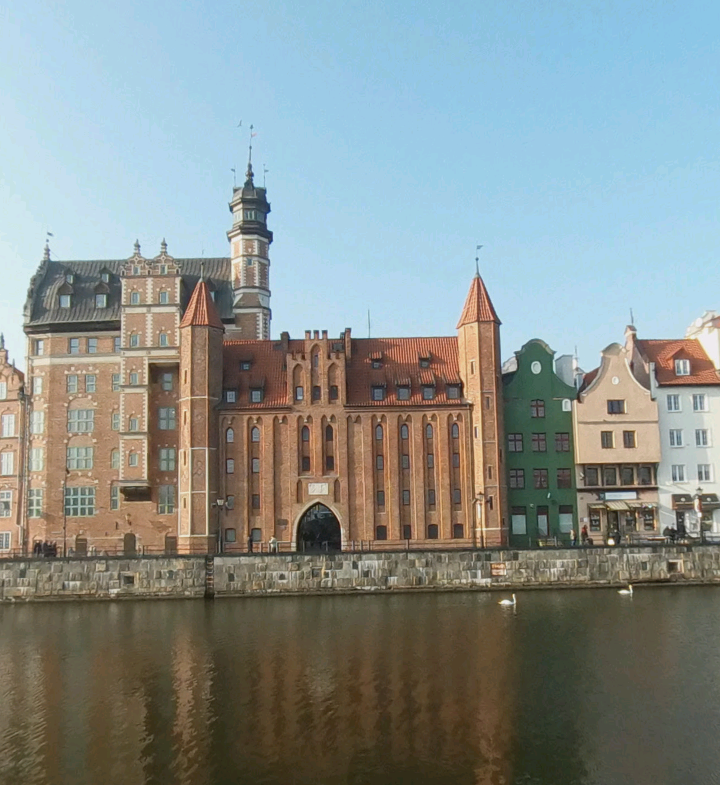
The following scenes of Gdansk begin in the Long Market, which is the main square of Gdansk, at the Neptune Fountain. The river is the Motlawa River and the wooden structure that is visible on one of the buildings facing the river is a medieval port crane. Being a port city, Gdansk has had much contact with other countries and it is believed that Dutch architecture, in particular, influenced some of the buildings. The structure with entrance archways is the Sixteenth-Century Green Gate. The building with the tall spire is the even older town hall.

These images from Google Street View are the Long Market and riverfront of Gdansk.


https://www.google.com/maps/@54.3485986,18.6528792,3a,75y,95.39h,90t/data=!3m7!1e1!3m5!1s4XDT0sWvjX7MUhbiKijniw!2e0!6s%2F%2Fgeo1.ggpht.com%2Fcbk%3Fpanoid%3D4XDT0sWvjX7MUhbiKijniw%26output%3Dthumbnail%26cb_client%3Dmaps_sv.tactile.gps%26thumb%3D2%26w%3D203%26h%3D100%26yaw%3D99.19379%26pitch%3D0%26thumbfov%3D100!7i13312!8i6656

Here is more of the old part of Gdansk.

https://www.google.com/maps/@54.3521923,18.6491919,3a,75y,216.88h,90t/data=!3m5!1e1!3m3!1sFQnN9CnqylItX_mISQxpfw!2e0!6s%2F%2Fgeo2.ggpht.com%2Fcbk%3Fpanoid%3DFQnN9CnqylItX_mISQxpfw%26output%3Dthumbnail%26cb_client%3Dmaps_sv.tactile.gps%26thumb%3D2%26w%3D203%26h%3D100%26yaw%3D203.615%26pitch%3D0%26thumbfov%3D100

This is the Gdansk Shipyard where the Solidarity Movement began that ultimately led to the end of Communist control.

https://www.google.com/maps/@54.3714039,18.6536315,3a,75y,64.86h,90t/data=!3m7!1e1!3m5!1sZzfKmqHy_H473gxNAixtiQ!2e0!6s%2F%2Fgeo1.ggpht.com%2Fcbk%3Fpanoid%3DZzfKmqHy_H473gxNAixtiQ%26output%3Dthumbnail%26cb_client%3Dmaps_sv.tactile.gps%26thumb%3D2%26w%3D203%26h%3D100%26yaw%3D51.147064%26pitch%3D0%26thumbfov%3D100!7i13312!8i6656

After Poland came back into existence in 1918, Gdansk was not actually part of Poland. It wasn't under East Prussian control either, which it bordered, although it's population at the time was almost entirely German. Gdansk was still used as a port for Poland, but it was decided to build a new port city on the Baltic Sea coast that was entirely under Polish control. The result was the city of Gdynia. This is the city of Gdynia, although some of the scenes are of nearby Gdansk.

https://www.google.com/maps/@54.5208357,18.5416821,3a,75y,100h,100t/data=!3m7!1e1!3m5!1s_yoBBXMhtt41X8QmXhgGgQ!2e0!6s%2F%2Fgeo0.ggpht.com%2Fcbk%3Fpanoid%3D_yoBBXMhtt41X8QmXhgGgQ%26output%3Dthumbnail%26cb_client%3Dmaps_sv.tactile.gps%26thumb%3D2%26w%3D203%26h%3D100%26yaw%3D100%26pitch%3D-10%26thumbfov%3D100!7i13312!8i6656

Bydgoszcz is yet another charming medieval city. The following scenes of Bydgoszcz begin in Old Market Square, from the Fourteenth Century. Image from Google Street View.


https://www.google.com/maps/@53.1217266,18.0002447,3a,75y,89.45h,90t/data=!3m5!1e1!3m3!1sn9f2jTQYoJpoN73MtoeiEQ!2e0!6s%2F%2Fgeo0.ggpht.com%2Fcbk%3Fpanoid%3Dn9f2jTQYoJpoN73MtoeiEQ%26output%3Dthumbnail%26cb_client%3Dmaps_sv.tactile.gps%26thumb%3D2%26w%3D203%26h%3D100%26yaw%3D89.0809%26pitch%3D0%26thumbfov%3D100

Szczecin is another city from the early middle ages. It has been under Viking, Polish, Danish, Swedish, Holy Roman Empire, German, and finally back to Polish, control.

https://www.google.com/maps/@53.4243053,14.5596706,3a,75y,76.91h,90t/data=!3m7!1e1!3m5!1sVNm3RME4jTFc30S6biPcoA!2e0!6s%2F%2Fgeo2.ggpht.com%2Fcbk%3Fpanoid%3DVNm3RME4jTFc30S6biPcoA%26output%3Dthumbnail%26cb_client%3Dmaps_sv.tactile.gps%26thumb%3D2%26w%3D203%26h%3D100%26yaw%3D68.68622%26pitch%3D0%26thumbfov%3D100!7i13312!8i6656

Following is the town of Strzelno. This is the town where Albert Michelson was from, who made the first realistic measurement of the speed of light, and it is a chance to see a medieval town in Poland. Marie Curie, maiden name Sklodowska, was another famous Polish scientist, she is credited with identifying what radioactivity really is, and she ultimately died from exposure to it. Marie Curie was from the New Town in Warsaw.

https://www.google.com/maps/@52.6285237,18.1730358,3a,75y,111.57h,90t/data=!3m7!1e1!3m5!1s-8728M7yotJrUEebIQLtHg!2e0!6s%2F%2Fgeo3.ggpht.com%2Fcbk%3Fpanoid%3D-8728M7yotJrUEebIQLtHg%26output%3Dthumbnail%26cb_client%3Dmaps_sv.tactile.gps%26thumb%3D2%26w%3D203%26h%3D100%26yaw%3D123.06971%26pitch%3D0%26thumbfov%3D100!7i16384!8i8192

Remembering The Mystery Of Ustica

The former prime minister of Italy recently expressed an opinion that agrees with what we saw in section 3) THE MYSTERY OF USTICA of the compound posting "Investigations", December 2018.

It is about the crash of an Italian passenger plane on June 27, 1980, which killed all on board. The plane was accidentally shot down in an attempt to assassinate Moammar Gaddafi, who had attended a meeting in Italy, that went horribly wrong.

Can you see how things work out? The interview was released on the fortieth anniversary, plus one day, of the shooting down of the Korean passenger jet in 1983, just as the Italian passenger jet was shot down on the fortieth anniversary, minus one day, of the shooting down of the chief of the Italian Air Force, in the Libya that would later be ruled by Moammar Gaddafi.

To further the irony the Italian air base where the plane was going to land when it was "accidentally" shot down would later be America's Wheelus Air Force Base, until Gaddafi came to power. In 1986 America bombed it's own former base, as well as Gaddafi's house, in what was apparently another attempt to assassinate Gaddafi.

What would Ronald Reagan have thought if he had lived long enough to see his arch-foe overthrown and killed by his own people?

An Explanation Of Lagrangian Points

In sending observational spacecraft into space Lagrangian Points are becoming ever more important. Whenever a smaller object is in orbit around a larger object, such as the earth around the sun, five Lagrangian Points are created. These points are usually defined as the locations where there is a balance between the gravity of the earth and that of the sun. The points are labeled L1 to L5.

The James Webb Space Telescope is positioned at L2 and India's spacecraft to observe the sun is on the way to L1. L2 is defined as the point in space beyond the earth, in a line with the sun, where the earth and sun's gravity balances. L1 is the point of balance in the direction of the sun.

Defining Lagrangian Points as the point where the gravity of the earth and sun balances is a way to give an idea of the concept but is actually not accurate. The earth's Lagrangian Points are well beyond the orbit of the moon. But the point where the gravity of the earth and sun are equal is closer to the earth than the moon.

We know that gravitational force is proportional to mass and diminishes with distance according to the Inverse Square Law. From the moon the sun is 400 times as distant as the earth. So if the earth and sun had the same mass the gravitational force of the earth on the moon would be 160,000, which is 400 squared, times as great as that of the sun.

But the mass of the sun is 330,000 times that of the earth. This means that, from the moon, the gravitational force of the sun is more than twice that of the earth. The point where the gravity of the earth and is equal must thus be between the earth and the moon, while L1 and L2 are defined as being well beyond the orbit of the moon.

What a Lagrangian Point actually can be defined as is the point on a line that includes both the earth and the sun where the gravity of the earth adds to or subtracts from the gravity of the sun so that the orbital period of an object at that point around the sun is the same as the earth, even though the object is closer or further from the sun than the earth.

When a planet or an object orbits the sun, the closer it is to the sun the faster it moves in it's orbit. This is because the gravity of the sun is stronger in close. An object at L2 would normally move more slowly than the earth through it's orbit, because it is further from the sun, and an object at L1 would normally move faster through it's orbit because it is closer to the sun.

Lagrangian Points are created because the earth has gravitational force also. It is nowhere as near as great as the sun but it is enough to make a difference.

An object at L1 is closer to the earth than the sun but the earth is in the opposite direction than the sun. This causes the earth's gravity to effectively subtract from the sun's gravity so that the object moves more slowly in it's orbit around the sun than it otherwise would. In fact it moves at just the right speed so that it's year is exactly the same as the earth's, and so it stays at a stationary point relative to the earth. It's orbital velocity is actually slower than earth's because the circumference of it's orbit is less.

In a similar way an object at L2 is further from the sun than earth so it would ordinarily move around the sun more slowly than the earth. But the earth's gravity adds to that of the sun so that it's year is exactly the same as that of the earth. It stays in a stationary point relative to earth. It's orbital velocity is actually faster than that of the earth because it's orbital circumference is longer.

That is the actual definition of Lagrangian Points.

Related to this idea is what we saw in the compound posting "The Moon", August 2023, section 2) THE EARTH, THE MOON AND, THE SUN. The moon is technically not in orbit around the earth. It is in orbit around the sun, as is the earth, because the force of the sun's gravity on the moon is more than twice that of the earth's gravity. What is happening is that the moon moves slower when it is between the earth and the sun, at new moon, and faster when it is opposite the earth from the sun, at full moon. This causes it to fall behind, and then pull ahead, of the earth so that it effectively orbits the earth.

Another thing that is related to this is geostationary orbits. A satellite will orbit earth more slowly the higher altitude it is. Meanwhile the earth is rotating. This means that, if a satellite is placed at a certain altitude, it will orbit the earth just as fast as the earth rotates so that it appears to stay directly overhead. This is known as a "geostationary" orbit and is at 22,300 miles.

Thursday, August 31, 2023

Warsaw And The Beginning Of Poland

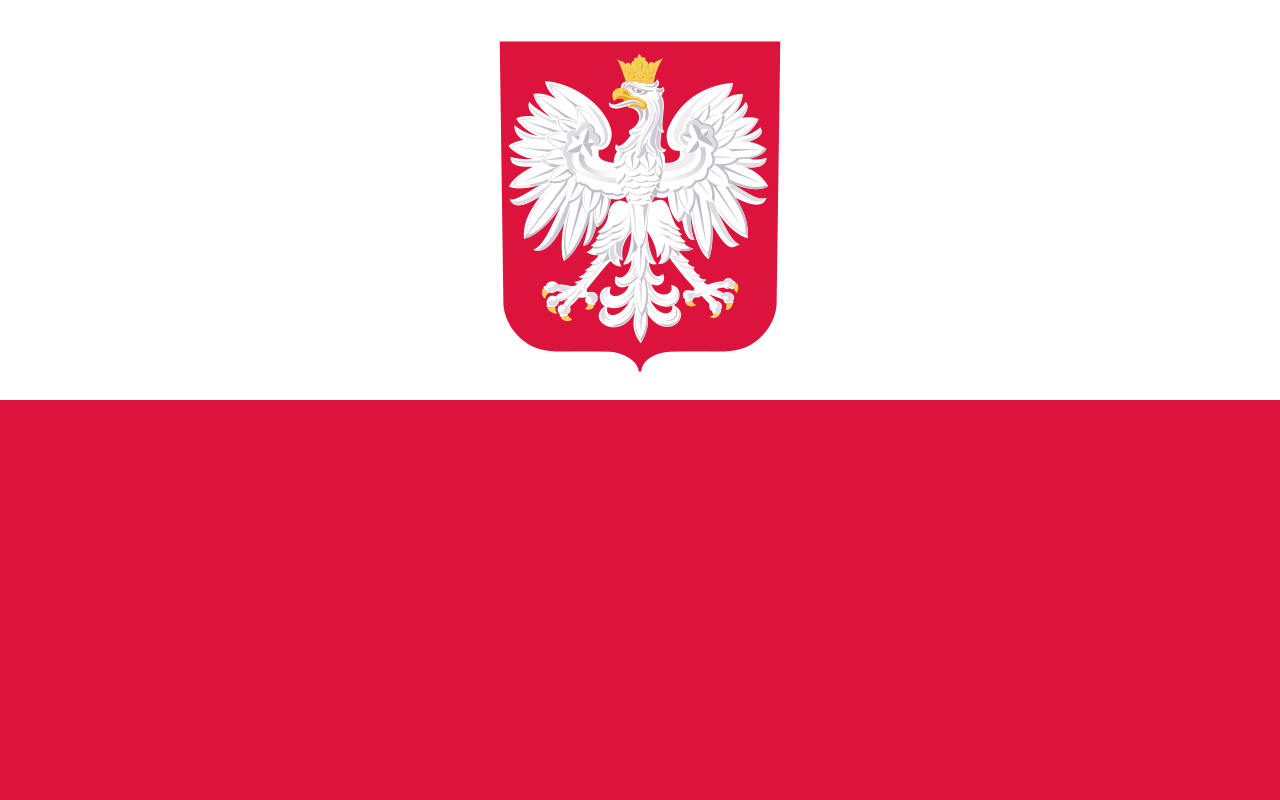
According to legend, although there is no reason not to believe it, a hunter named Lech, one of three brothers, came across the magnificent sight of a white eagle perched against the backdrop of a brilliant red sunset. Taking it as an omen, Lech founded a settlement on the site.

It was to be the beginning of a nation. The settlement is today called Gniezno and it's cathedral is where kings of Poland would be crowned. A ruler named Mieszko I would convert to Christianity and make it the religion of Poland. His son, Boleslaw I, would be crowned as the first king of Poland.

The flag of the nation would be the white of the eagle and the red of the sunset.

https://en.wikipedia.org/wiki/Flag_of_Poland#/media/File:Flag_of_Poland.svg


https://upload.wikimedia.org/wikipedia/commons/1/15/Flag_of_Poland_%28with_coat_of_arms%29.svg 

This is the statue of Boreslaw I at Gniezno Cathedral. Google Street View.


The following views of Gniezno begin at the statue of Boleslaw I outside the cathedral.

There are multiple scenes following. To see the scenes, after the first one, you must first click the up arrow, ^, before you can move on to the next scene by clicking the right or forward arrow, >, After clicking the up arrow, you can then hide the previews of successive scenes, if you wish.

https://www.google.com/maps/@52.5363315,17.5918379,3a,75y,1.06h,95.4t/data=!3m7!1e1!3m5!1sg2Uqm2vK6RnswJXlcWZZlg!2e0!6s%2F%2Fgeo0.ggpht.com%2Fcbk%3Fpanoid%3Dg2Uqm2vK6RnswJXlcWZZlg%26output%3Dthumbnail%26cb_client%3Dmaps_sv.tactile.gps%26thumb%3D2%26w%3D203%26h%3D100%26yaw%3D143.25032%26pitch%3D0%26thumbfov%3D100!7i13312!8i6656

The national identity of Poland is simple and easy to define. Poland is the land of the Slavs of northern Europe who stayed with Catholicism.

In the Great Schism of 1054 their fellow Slavs, the Russians, split from the Catholic Church to form the Eastern Orthodox Church. That led to the corresponding split, and historic rivalry, between Poland and Russia.

To the west were the fellow Catholics of the Holy Roman Empire. Poland was recognized by the Holy Roman Empire but was not part of it. The Reformation, beginning in 1517, spread quickly through most of the Holy Roman Empire. Germans, to the west, and Sweden, to the north, became Protestant and often rivals of still-Catholic Poland, where the Reformation had little effect. There were also ethnic and language differences involved.

The ubiquitous Polish surname suffix of -ski simply means "from" or "having to do with". In English, a smith is someone who makes something, like blacksmith, metalsmith or, goldsmith. The German equivalent is Schmidt. The very common name of Kowalski is the Polish equivalent of Smith. "Kowalski" seems to mean "Having to do with making something".

The common Szcz- prefix or suffix in Polish names simply means "happiness".

Warsaw is the capital city of Poland and began in medieval times. The oldest part of the city is from the Thirteenth Century. These views from Google Street View is of Old Town Market Square.


The following views of Warsaw begin in the oldest part of the city, in Old Town Market Square. Not far away is Castle Square, the red building is the Royal Castle, where Poland's kings used to live. It is easy to tell the two squares apart because Old Town Market Square is rectangular in shape while Castle Square is triangular. Much of the wall still remains around the Old Town of Warsaw.

These two views, from Google Earth and Street View, are of Castle Square.


The following two views, from Google Earth and Street View, are of the Royal Castle, in Castle Square, where the kings used to live.


The column monument in Castle Square is of Sigismund III, the king who moved the capital of Poland from Krakow to Warsaw. The reason that Warsaw became the capital is that Poland was in a union with Lithuania, the Polish-Lithuanian Commonwealth, and Warsaw was halfway between the two capitals of Krakow and Vilnius.

This image of New Town from Google Street View.


https://www.google.com/maps/@52.2534514,21.0070641,3a,75y,74.34h,90t/data=!3m7!1e1!3m5!1sesbGHFtLO1Sha0bqY-KZSg!2e0!6s%2F%2Fgeo3.ggpht.com%2Fcbk%3Fpanoid%3DesbGHFtLO1Sha0bqY-KZSg%26output%3Dthumbnail%26cb_client%3Dmaps_sv.tactile.gps%26thumb%3D2%26w%3D203%26h%3D100%26yaw%3D65.388855%26pitch%3D0%26thumbfov%3D100!7i13312!8i6656

Here is the Seventeenth-Century Wilanow Palace.

https://www.google.com/maps/@52.1651679,21.0902293,3a,75y,251.53h,90t/data=!3m7!1e1!3m5!1sXzZ-9es_827KBdfeAYRCbw!2e0!6s%2F%2Fgeo2.ggpht.com%2Fcbk%3Fpanoid%3DXzZ-9es_827KBdfeAYRCbw%26output%3Dthumbnail%26cb_client%3Dmaps_sv.tactile.gps%26thumb%3D2%26w%3D203%26h%3D100%26yaw%3D241.42662%26pitch%3D0%26thumbfov%3D100!7i13312!8i6656

This is modern Warsaw. The tall stone building with the spire is the Palace of Culture and Science. It was built during the Communist era in the same style as Moscow's "Seven Sisters".

These three images, from Google Earth and Street View, are of the Palace of Culture And Science and the view of modern Warsaw from the top.


https://www.google.com/maps/@52.2334083,20.9982284,3a,75y,146.93h,90t/data=!3m5!1e1!3m3!1s19HbOw0RI7di_s12-5hrkg!2e0!6s%2F%2Fgeo3.ggpht.com%2Fcbk%3Fpanoid%3D19HbOw0RI7di_s12-5hrkg%26output%3Dthumbnail%26cb_client%3Dmaps_sv.tactile.gps%26thumb%3D2%26w%3D203%26h%3D100%26yaw%3D158.25598%26pitch%3D0%26thumbfov%3D100

Also in the central part of Warsaw, this is the area around Pilsudski Square. There used to be an axis around which Warsaw was built, the Saxon Axis, similar to the Historical Axis of Paris.

https://www.google.com/maps/@52.2413296,21.0136114,3a,75y,252.76h,90t/data=!3m7!1e1!3m5!1slEK6yCVSf1sJtfxhg7TpMQ!2e0!6s%2F%2Fgeo3.ggpht.com%2Fcbk%3Fpanoid%3DlEK6yCVSf1sJtfxhg7TpMQ%26output%3Dthumbnail%26cb_client%3Dmaps_sv.tactile.gps%26thumb%3D2%26w%3D203%26h%3D100%26yaw%3D243.11841%26pitch%3D0%26thumbfov%3D100!7i16384!8i8192

Here is some of the northern part of central Warsaw.

https://www.google.com/maps/@52.2549454,20.9832357,3a,75y,289.24h,90t/data=!3m5!1e1!3m3!1sKV0ploKgK813gSU9h0vVIw!2e0!6s%2F%2Fgeo1.ggpht.com%2Fcbk%3Fpanoid%3DKV0ploKgK813gSU9h0vVIw%26output%3Dthumbnail%26cb_client%3Dmaps_sv.tactile.gps%26thumb%3D2%26w%3D203%26h%3D100%26yaw%3D299.6926%26pitch%3D0%26thumbfov%3D100

Warsaw is located on the Vistula River. The Old Town and the central part of the city is to the west of the river. But much of Warsaw is on the east bank of the river. This is Warsaw east of the Vistula River, opposite the Old Town.

https://www.google.com/maps/@52.2537059,21.0369871,3a,75y,240h,100t/data=!3m7!1e1!3m5!1sqr3M310eGm4fS7u0tWEBfA!2e0!6s%2F%2Fgeo0.ggpht.com%2Fcbk%3Fpanoid%3Dqr3M310eGm4fS7u0tWEBfA%26output%3Dthumbnail%26cb_client%3Dmaps_sv.tactile.gps%26thumb%3D2%26w%3D203%26h%3D100%26yaw%3D240%26pitch%3D-10%26thumbfov%3D100!7i13312!8i6656

Here is a residential area, of mostly private homes, in Warsaw east of the Vistula River.

https://www.google.com/maps/@52.2206869,21.146183,3a,75y,340h,90t/data=!3m5!1e1!3m3!1sMAS2ELK56caLaiGm6EC-PQ!2e0!6s%2F%2Fgeo2.ggpht.com%2Fcbk%3Fpanoid%3DMAS2ELK56caLaiGm6EC-PQ%26output%3Dthumbnail%26cb_client%3Dmaps_sv.tactile.gps%26thumb%3D2%26w%3D203%26h%3D100%26yaw%3D340%26pitch%3D0%26thumbfov%3D100

This is a semi-rural residential area just north of Warsaw.

https://www.google.com/maps/@52.350089,21.0545161,3a,75y,100h,90t/data=!3m7!1e1!3m5!1sEX_QOkXBci3CtNcuHdJV7w!2e0!6s%2F%2Fgeo1.ggpht.com%2Fcbk%3Fpanoid%3DEX_QOkXBci3CtNcuHdJV7w%26output%3Dthumbnail%26cb_client%3Dmaps_sv.tactile.gps%26thumb%3D2%26w%3D203%26h%3D100%26yaw%3D100%26pitch%3D0%26thumbfov%3D100!7i13312!8i6656

After the end of the Polish-Lithuanian Commonwealth, Poland did not exist as an independent nation for over 120 years, before coming back after the First World War, in 1918. It's territory was split between Austria, Russia and, Prussia, which would become the leading state of modern Germany. But whatever government they lived under, Polish people never forgot being Polish and it was inevitable that Poland would return.

In the early Nineteenth Century, Napoleon built a brick fortress to the north of Warsaw. The fortress would be the focal point of military power in Poland during the time that it did not exist as an independent nation. This fortress in Poland is known as the Modlin Fortress. Here is Poland's Modlin Fortress.

This image from Google Street View.


Murder In Tonawanda, NY

I occasionally write about crime. This is my input on a very controversial and high profile murder that happened not far from here. Please remember that all my information is from what I have read in the news.

Tonawanda is a northern suburb of Buffalo, NY, that is not usually known for crime. On February 17, 1993, a woman named Deborah Meindl, age 33, was brutally murdered in her home, which was in the older section of Tonawanda not far from the Niagara River.

She had been stabbed many times, severely beaten, and strangled with one of her husband's neckties, which was still around her throat. A bloodied steak knife was found at the scene. It was a chaotic scene that appeared to have been a burglary.

Two men were convicted of the murder and spent a long time in prison, but their convictions have always been controversial. It was decided that they were burglarizing the house and killed Deborah Meindl when she arrived home. The murder took place in the afternoon. The victim arrived home sometime after 2 PM . Her young daughter arrived home just after 3 PM and found her body.

The house is an unlikely candidate for a burglary. They were a simple couple, she was a nursing student and her husband the manager of a fast food restaurant. They had two young daughters. There was no indication that they had much money or valuable possessions, and no sign that they were involved in anything like drug dealing.

The house is in a densely populated residential neighborhood and the murder took place in the afternoon, near the time that parents would be picking children up from school. People might have noticed someone walking, and carrying stolen goods, or a car parked near the house. The possibility of burglary was also complicated by the fact that there was snow on the ground, so that a burglar risked leaving footprints in the snow.

The two that were convicted were, at worst, petty thieves, and neither had shown any tendency to do anything like this. It didn't look anything like Deborah Meindl was murdered after having surprised burglars. The murder was overkill in the extreme. It looked far more like a crime of passion, where there was a lot of emotion involved.

Not only was it dramatic overkill, she had been severely beaten, stabbed countless times with the steak knife, and strangled with her husband's necktie. She was also found handcuffed, along with the tie still around her throat.

What this definitely looks like is a targeted killing, initially set up to look like a burglary. The first reaction is that her husband, or someone who had access to handcuffs, had committed the murder and arranged it to look like a burglary. But that would be just too obvious. Both the necktie and the handcuffs are false clues. It was designed to look like a crime of passion, that was set up to look like a burglary. 

Deborah Meindl's husband was cleared and there is no reason to believe that it is the work of a serial killer.

Now let's go to another story. Possibly the most famous native of Tonawanda is named Richard Matt, although not for a good reason. Richard Matt is famous for the prison escape that transfixed New York State in June of 2015. Matt, along with another prisoner named David Sweat, broke out of the Clinton Correctional Facility by cutting their way into a steam pipe, and from there into the town of Dannemora's storm drainage system. 

They emerged through a manhole cover a block outside the prison wall. After searching the Adirondacks for nearly a month Richard Matt was shot and killed and David Sweat was wounded and recaptured.

The manhole through which the two escaped is in the foreground, and the prison wall in the background. Image from Google Street View.

Richard Matt was in prison for committing a brutal murder. In 1997 Matt and an accomplice broke into the home of Matt's former boss, in neighboring North Tonawanda. They believed that the former boss had a lot of money in the house, and demanded to know where it was. 

The boss was bound with duct tape and shut in the trunk of the car. The two drove around for more than 24 hours, to Ohio and back, with him in the trunk and Matt stopping periodically to beat him. Matt finally killed him by snapping his neck. They hid his body on industrial Tonawanda Island, before returning later to cut it in pieces and throw the body parts in the Niagara River.

After committing this murder Richard Matt fled the area and managed to get across the border into Mexico. In a bar Richard Matt saw an American man and thought that he had a significant amount of money. In attempting to rob the man Matt stabbed him numerous times, killing him. Matt was caught and convicted and spent nine years in a Mexican prison. 

When Mexico extradited a drug dealer to the U.S. they put Matt on the plane as well. He was then convicted of the 1997 murder of his former boss. In Clinton Correctional Facility his cell was next to that of David Sweat. The two became friends and eventually made their famous escape, which ultimately ended with Matt being shot and killed and Sweat wounded and recaptured.

Now back to the murder of Deborah Meindl. When she was brutally murdered Richard Matt was living a few minutes walk away. From what I have read a witness saw a young man walking up the driveway of the house. Richard Matt would have been 26 at the time.

After his recapture, with Richard Matt dead, David Sweat wrote a long letter to the news claiming that Richard Matt had told him that he killed Deborah Meindl. The letter described details of the crime that Matt allegedly told him.

What is happening here now is that the convictions of the two men for the murder have been overturned. They are to be given new trials. But the local judicial establishment is very resistant to the idea that Richard Matt might have committed the murder.

How would David Sweat know details about this murder if Richard Matt hadn't told him? David Sweat is from the other end of the state, the Binghamton NY area, and was 12 years old when Deborah Meindl was murdered. I cannot see that he had ever been to the Buffalo area.

David Sweat has little to gain for helping to solve a crime. He killed a police officer by shooting him and then purposely running him over with a vehicle. He was sentenced to life in prison with no possibility of parole. Then he made his famous escape, which thoroughly embarrassed the prison system and cost the state more than 20 million dollars. There is no way he will ever get paroled from prison, even if he does help solve a crime.

Look at the similarities between Richard Matt's two known murders and the murder of Deborah Meindl, in 1993. The murder of Matt's former boss took place in 1997, and the murder of the American man in Mexico in 1998.

Richard Matt broke into his former boss's house just as the murderer of Deborah Meindl broke into her house.

Richard Matt restrained his former boss with duct tape and by locking him in the car trunk just as Deborah Meindl's murderer had restrained her with handcuffs.

Richard Matt brutally beat his former boss just as Deborah Meindl had been brutally beaten.

Richard Matt snapped his former boss's neck just as Deborah Meindl had been strangled with the tie.

Richard Matt stabbed the American man that he was trying to rob in Mexico many times just as Deborah Meindl had been stabbed with the steak knife many times.

This most definitely points toward Richard Matt.

For more about crime see "Insights Into Major Crimes", September 2024.

Smile

I would just like to mention how impressed I am at the smiling of my high school class at a recent reunion. It is worthy of a commercial. Everyone looks like they have just joined Sam's Club and are deleriously happy about all the money that they will be saving.

My spirit has always attended class reunions. Don't forget that the Million Year Reunion is the most important one of all.

Thursday, August 24, 2023

The Baltics

The Baltics are the three former Soviet republics on the Baltic Sea, Lithuania, Latvia and Estonia. These are small countries and have historically been under a lot of influence of neighboring powers Russia, Poland, Germany and, Sweden.

Lithuania is the Baltic country that is immediately north of Poland. After the Great Schism of 1054 and then the Reformation, in 1517, Poland and Lithuania formed an "island" of  Catholicism in northeastern Europe, with Russia to the east being Eastern Orthodox and the other two Baltic states, Latvia and Estonia, being more affected by the Reformation.

The Grand Duchy of Lithuania is believed to have once been the largest nation in Europe. Poland and Lithuania later united to form the Polish-Lithuanian Commonwealth. The capital of Lithuania was Vilnius and the capital of Poland was Krakow. Warsaw is now the capital of Poland because the capital was moved there as it was halfway between Krakow and Vilnius. My observation is that the Polish-Lithuanian Commonwealth somewhat resembles the later Austro-Hungarian Empire in that the two states formed a partnership that was short of outright unity.

Vilnius is a city from the Thirteenth Century. Like the other major cities of the three Baltic nations, it was built around a castle. The following image from Google Street View is of Gediminas Tower, within the castle.


Vilnius Cathedral, adjacent to the castle, is the building with the pillars. Images from Google Street View.


The following image from Google Street View is of Pilies Street, in the Old Town of Vilnius adjacent to the castle.


The following scenes are of the Old Town of Vilnius.

There are multiple scenes following. To see the scenes, after the first one, you must first click the up arrow ^, before you can move on to the next scene by clicking the right or forward arrow, >. After clicking the up arrow, you can then hide the previews of successive scenes, if you wish.

https://www.google.com/maps/@54.6783521,25.2871091,3a,60y,90t/data=!3m6!1e1!3m4!1s5X8-eY24VGM50MWGX7eqQQ!2e0!7i13312!8i6656

This more of Vilnius Old Town. The founding myth of Vilnius is a dream of Gedaminas of an iron wolf. The main street of Vilnius Old Town is Pilies Street, which runs between two squares.

https://www.google.com/maps/@54.6860982,25.2888485,3a,75y,95.8h,90t/data=!3m8!1e1!3m6!1sAF1QipP6HA4ntugi_EffUVYqo7Zg_hSb4qsGh4Ds4QFK!2e10!3e11!6shttps:%2F%2Flh5.googleusercontent.com%2Fp%2FAF1QipP6HA4ntugi_EffUVYqo7Zg_hSb4qsGh4Ds4QFK%3Dw203-h100-k-no-pi0-ya8.972-ro-0-fo100!7i8704!8i4352

Kaunas is another large city in Lithuania. It was also built around a castle, one from the Fifteenth Century. This is the Old Town of Kaunas. Image from Google Street View.


https://www.google.com/maps/@54.8974621,23.8894095,3a,60y,90t/data=!3m6!1e1!3m4!1sQgj-xDw1PRq_Pc5aV98bPQ!2e0!7i13312!8i6656

Klaipeda is Lithuania's primary port city, which also grew up around a castle. It could be seen as Lithuania's version of Gdansk.

https://www.google.com/maps/@55.7082679,21.1327047,3a,60y,90t/data=!3m6!1e1!3m4!1sgDsQh-A_2re84CtQ4RI_TA!2e0!7i13312!8i6656

In Lithuania there is the "Hill of Crosses". This is a hill where many tens of thousands of crosses have been placed and it is a site of pilgrimage. It was also the focal point of Lithuanian national identity during the time of Communist control. The Communists reportedly bulldozed the site several times and even made plans to build a dam so that the site would be underwater. Two images from Google Street View.


This is the historical center of Riga, known as Veoriga. The towering structure with the statue atop is the Freedom Monument. The Brotherhood of Blackheads building is a guildhall. The image from Google Street View is of Riga's Freedom Monument.


https://www.google.com/maps/@56.9495138,24.1053073,3a,60y,90t/data=!3m6!1e1!3m4!1sgY11h1dS0pLVvBDDKC_NxQ!2e0!7i13312!8i6656

This is Riga away from oldest part of the city.

https://www.google.com/maps/@56.9580213,24.1248103,3a,60y,90t/data=!3m6!1e1!3m4!1sgYrukLyLy2LR9p6h4AqMgQ!2e0!7i13312!8i6656

Daugavpils is a Latvian city from the Thirteenth Century.

https://www.google.com/maps/@55.8727519,26.5185822,3a,60y,90t/data=!3m6!1e1!3m4!1sjeDI7XuE5Z3lVl9lpWpAYw!2e0!7i13312!8i6656

Tallinn is the capital city of Estonia, the northernmost of the three Baltic nations. Like a number of other cities in the Baltic nations, it dates from the Thirteenth Century, and is also built around a castle, Toompa Castle on Cathedral Hill, which is where the Estonian Parliament is now located. Here is the Old Town of Tallinn, from Google Street View.

General News

THE PRICE OF THE ALAMO

We recently saw the Alamo in our visit to Texas. The Alamo is a storied place in American history. It is where a band of American settlers in Mexican Texas refused to surrender when besieged by a larger Mexican force. They fought to the death.

Despite the place of the Alamo in American history the battle there wasn't about America. Texas was one of several regions of Mexico that attempted to break away at the time. It was about Texas becoming an independent republic. It would be years before it became part of America. Mexico had allowed Americans to settle in sparsely-populated Texas in an effort to counterbalance hostile native Indian tribes.

But there is a price to pay for glamorizing the seige of the Alamo. 

Armed standoffs, by either a group or an individual, have a prominent place in American history. If you do a web search for "standoffs" it will display the most recent ones. A search for "list of standoffs" will show the many prominent standoffs of recent decades.

All of these standoffs have an element of being a reenactment of the Alamo.

BLUE DENIM

Denim became popular in America's Old West. The West began to be settled, on a large scale, after the end of America's Civil War, in 1865. The Civil War was won by the Union, against the Confederacy. 

Is it just a coincidence that the blue of denim is exactly the same color as the army uniforms of the victorious Union? Would denim be gray if the Confederacy had won?
POLITICS AND SPACE EXPLORATION

The use of feats of space exploration for political purposes is nothing new. A prominent part of the Cold War was the Space Race. What about India's space program? Was it a coincidence that the mission to Mars arrived just as Xi Jinping was visiting New Delhi? And now the mission to the moon has arrived just as the most important BRICS conference ever is beginning. 

Checklist For The Next Revolution

With all the news of potential coups and revolutions nowadays, including America's January 6, remember that a revolution is an ideal opportunity to change the basic way that things are done. The Metric System, that is used across the world, is a product of the French Revolution. It may never have caught on without it's use being driven by that revolution.

I am not necessarily saying that there should be a revolution. But here are some ideas for basic improvements in the way things are done whenever the next revolution should come along.

NAMING THE WEEKS

Why we don't name the weeks, instead of the months. Almost everyone lives much more by the week than by the month. The months were originally based on the lunar cycle but the week has been more important than the month ever since the Industrial Revolution.

It is a great inconvenience that we cannot express weeks by name. We have to use awkward terms like "about six weeks ago" or "the week of December 2-9". We use the month to express the week, but the week is far more important for most people.

There are 52 weeks in a year with one day left over, two days left over every four years. 

I also think that the year should begin on either perihelion, January 4 when the earth is closest to the sun, or aphelion, July 4 when it is furthest from the sun. This would make it easier to plot the location of the earth in space. January 1 was randomly chosen in ancient times to begin the year.

America has 50 states, plus Washington D.C. and Puerto Rico. How would Americans like a calendar that begins on what is now the Fourth of July, which also happens to be aphelion, with each week named for a state?

Most of the world usually goes by the Gregorian Calendar. But even those that don't use it agree on the days of the week. Just as the days of the week are expressed in different languages now, it will not be necessary to agree on names for the weeks. Everyone can call them whatever they want.

COUNTING BY TWELVES

In the compound posting, "Measurements" September 2021, we saw how much better off we would be if we counted by twelves. We count by tens, because we have ten fingers, but twelve is much more evenly divisible than ten and so more efficient.

We instinctively revert to counting by twelves wherever divisibility is important, including the hours in a day. Eggs are sold by the dozen because it is more likely to be evenly divisible among the members of a family. For the number of seconds in a minute and minutes in an hour we use a nice round evenly-divisible number that is a multiple of twelve. We use the same principle for the 360 degrees in a circle.

In fact I consider counting by tens, rather than by twelves, to be one of the greatest mistakes that humans have ever made.

Also on that compound posting is how we could benefit from revised definitions of the coulomb and the meter, both of which are entirely arbitrary units.

A coulomb is the unit of electric charge. A flow of one coulomb per second is called an ampere. A mole is the number of atoms or molecules in a sample of matter whose mass in grams is equal to the atomic or molecular weight of the atoms or molecules. 

A coulomb is close to, but not quite, being one ten-thousandth of Avogadro's Number, which is the basis of the mole. Since electrons come from atoms I think it would be very useful and convenient to redefine the coulomb, which is the number of electrons, as one ten-thousandth of a mole.

The acceleration due to gravity of a falling object is 9.8 meters per second squared. Since we are now in the era of aerial warfare and space travel, and since units of the Metric System are supposed to be based on multiples of ten, wouldn't it be better to shorten the definition of the meter a little bit, to what is now 98 cm, so that the acceleration due to gravity was exactly 10 meters per second squared?

THE CHARGE CONUNDRUM

What I refer to by this is that there are negative and positive electric charges. We have arbitrarily deemed the charge on an electron to be negative and that on the proton positive.

The trouble with this is that the plus and minus signs that we use to denote positive and negative also mean gaining and losing. When an atom loses an electron it results in the atom having a net positive charge, a positive ion. Likewise when an atom gains an electron it ends up with a net negative charge.

It doesn't sound like it makes sense. In an oxidation-reduction chemical reaction an atom undergoes reduction by actually adding electrons to it, because an electron has a negative charge.

Wouldn't it make more sense to say that the electron has a positive charge and the proton a negative charge? This is actually what antimatter is.

MISNOMERS

There are still misnomers around, which are gradually being corrected. There used to be "tidal waves", except that they are caused by undersea earthquakes and have nothing to do with tides. A better term is the Japanese word for it, "tsunami".

We are in the Space Age but there are still references to "the dark side of the moon". The same side of the moon always faces earth and this refers to the side that faces away from earth.

But not only is it not "the dark side of the moon", it actually gets more sunlight than the side that faces earth. I say that the far side gets more sunlight because it is totally facing the sun (new moon) when it is between the earth and the sun, meaning closer to the sun, while the side that faces the earth is totally facing the sun (full moon) when the moon is on the opposite side of earth from the sun, meaning further from the sun.

NATIONAL SYMBOLS

So many nations have vicious wild predators, such as lions and eagles, as their national symbols. How much sense does it make to have a predator as the national symbol, and then lock people in prison for conducting themselves like the national symbol?

Why don't we have plants as our national symbols? Canada has the maple leaf. But this does not mean marijuana.

This is being written near the city of Buffalo and I have always thought that the buffalo would make a better symbol for America than the eagle. There are eagles in much of the world but the buffalo is more uniquely American.